
Tag Archives: Paleo

Confessions of an accidential Caveman #2: Running toward a new border

Growing up, we Plunketts were a fast food family.
In fact, one of our hallowed religious traditions involves fast food.
At one point, we lived six houses from Taco Bell and running for the border was a favored pastime. One Easter, we were low on funds and time, so we went off to Taco Bell for a quick Easter lunch. We were the only people in the restaurant but it was one of our better Easter lunches. Our family maintained that tradition for many years. It’s a good reminder of how things were and the constant renewal of life.

My mother is a great cook. Self-taught, she figured out how to make fantastic pasta dishes and her chicken enchiladas and albondigas soup is to die for. Whenever she could cook dinner, she will. Even now, weeks before I’m set to arrive for a visit west, my mother texts to ask what I want to eat while I’m staying with my parents.

Dad is an expert omelet-flipper. Really, it’s pretty impressive. I have yet to master that skill; hence the constant scrambles for breakfast.

Sometimes (actually, it was every and often), he mixed up his spices, putting poultry seasoning on toast and putting ginger on well, everything. He’s also a fan of chocolate pudding and potato chips, together. In one bite.

I guess that’s what happens when times change, but values don’t. (Sorry, inside joke.)

Otherwise, we ate fast food, a lot. Both my parents worked long hours in our middle-middle class upbringing in the quintessential suburban neighborhood in California, which predicated on lots and lots of fast food.

The High School Athletic Wall of Fame is located at the McDonald’s on Woodruff and Del Amo. Allegedly, One of the first McDonald’s is up Lakewood Avenue in Downey, it’s art deco signage still in use.

After church on Sundays and youth services on Wednesdays, my friends and I were either at Taco Bell, In ‘N Out (God Bless the Double Double!) or Fuddruckers. Our pastor’s signature line to encourage fellowship was, “Now, everyone go out and have a cheeseburger!” We Evangelicals were big into literalism, so cheeseburgers it was.

Mind you, this is the 90s, before Starbucks went public and the coffee shops started popping up all over the place. In college, our group was at the Buck or the “holy sanctum” of coffee, Coffee Bean and Tea Leaf (I’ll provide the sacred and profane sermon regarding coffee shops another time).

Nevertheless, it was fast food that ruled the day.

I write the above noting that fast food restaurants have changed and continue to evolve. This was before Fast Food Nation, Food Inc and much of our growth in food awareness. Anyone who was a vegetarian, a vegan or god forbid, trying a paleo diet would have gotten stares or in the case of my childhood, the verses in Scripture about how it’s perfectly acceptable (thus Biblically mandated) to eat meat.

Also, it’s an indictment against our consumer industrial complex and how much of the fast food industry disenfranchises the poor, who can only afford fast food to get through the day. While it’s “cheaper” than most food, you don’t truly know how your food is made or produced. While it’s a good starting job for those entering the work force, it bumps corporate profits at the expense of employee health and well being.

What I want to focus on is process, specifically, the joy of cooking your own food.

20140221-142110.jpg

Apropo of nothing, hot dogs are a delicacy in Chile. This was lunch one day in Santiago. And I wanted a photo of hot dogs in this post.

For years, food preparation was a necessary evil

My cooking skills are elementary. My spaghetti sauce is well known among the circle of friends and former roommates. The Plunkett specialty is chicken and dressing. Chicken and dressing consists of chicken, sour cream, cream of chicken, dressing and Chinese noodles. Add butter, lots of butter, and there was the best I offer, food-wise.

The night work schedule added to the lack of time and convenience to cook. Partly my desire to get out of the newsroom for any moment (Rule #1 to work: Leave as often as possible!), it was a stop for fast food. In downtown, D.C. the options were Subway, pizza that is nothing close to being authentic, Cosi and Five Guys.

Fridays were reserved for Five Guys, so I ate fresh often. As you can see, my eating patterns weren’t the gold standard of healthy eating. My eating consisted of about 20% of my own cooking and 80% of eating out.

Everyone has his/her own reasons for how they eat and what they eat. In my instance, fast food was convenient but more so; it was a comfort and perhaps a sense of security. It buffers against the stress of the job and provided a sense of a home from which I am far away. Fast food also was an opt-out against a deep-rooted fear, the inability to take care of myself. I’m on my own and have grown past the typical bachelor stereotype of empty pizza boxes in the corner. (Now, it’s empty Whole Foods bags in the corner but I digress.) Too often, I allowed that perception to rule my life. If I don’t have anyone else to cook for, which should I put in the time and effort? No one is going to care, so why should I?
The biggest change in switching out was changing the default mode. As the majority of food decisions are automatic and semi-conscious, it takes mindful effort to adjust the process of eating. For me, it was addressing those fears head-on.
Three Christmases ago, my parents gave me Mark Bittman’s How to Cook Everything. That book saved my bacon. Two Christmases ago, my parents also got me a slow cooker and that has been my faithful friend and companion.

20140221-142041.jpg

One of the first meals I made. Slow-cooked pork and a kale dish that includes cashews, onions and cranberries. ENDORSE.

Now, I own a cask-iron skillet, a Dutch oven, some pots and pans and a steady stream of olive and coconut oils, cumin and pepper. While I enjoy a fine dining experience now and then, my food passions reside in finding hole in the walls and unlikely spots, a la Fast Gourmet (which was a heartbreak in not eating there multiple times a week).
Cooking is still a process, with bits of enjoyment and pleasure. Mostly, I appreciate the chance to make something I know I’ll enjoy. Fast, well, faster food is still an ongoing issue. It’s come to the point where the food ratio has flipped: I cook about 80% of my own food and eat out about 20% of the time.
To this day, I still eat Taco Bell for Easter lunch. It’s the only time in the year I’ll eat Taco Bell. As an adult, the tradition means more to me now than the food.

Sometimes, it takes a 99-cent burrito to celebrate renewal.

Let’s talk: How much does fast food dictate your eating habits? Is it a joy or a struggle? And any great fast food options that are healthy?
Confessions of an accidential caveman #1: Break all your fasts

Note: I’m coming close to one year of switching over the paleo food template. Amazingly enough, it’s stuck and really become a life-long mindset. These posts deal with how I got here and how my life has changed.

For years, I didn’t eat breakfast. Because of a second-shift job, my breakfast was usually lunch.

If I was up for breakfast, it was donuts. Lots of donuts. And coffee with cream and sugar. That was it: Sugary, creamy coffee and donuts. One would think I was a cop but I was a journalist (a far worse predicament).

I always heard that breakfast was the most important meal of the day. I never believed it. When my energy levels were low for the day and I required more and more sugar to keep going, I didn’t give a second thought to how I ate. I just ate. That, combined with a stressful job in a stressful city, leads to major problems.

I can’t tell you how many boxes of Pepto Bismol I’ve consumed. The stomach-aches, lethargy, continue struggles with acne and being overweight, all constants for most of my late 20s and early 30s. It was a given that after eating wheat, my throat would seem to close in, making it difficult to breathe and swallow. This would last a few minutes before I would finish eating whatever pasta or burritos I purchased.

A week after starting at the Post in summer 2010, my body was in extreme pain. After checking into the emergency room for fear of appendicitis, the doctors asked me about my high blood pressure and struggles with digestive issues.

Look, I just started a new job after months of unemployment; of course I have high blood pressure! I joked the doctors. I was fine but they told me to think seriously about changing my diet.

I didn’t. I walked home because I didn’t want to pay for a cab. I didn’t have any money and because my new health insurance hadn’t kicked in, it would be some time before I had money again (and that’s worth multiple posts but I’ll leave that for another time).

It wasn’t those issues that began the change. For me, it was staring in the mirror that I realized something: I don’t look the way I feel. When I had energy, felt alive, I saw one version of myself. But what was staring back at me was another version. It was that disconnect that was a trigger for needed change. I wanted my outside to match how I felt on the inside.

The Whole30 challenge was the first time I had to think about eating and how I felt about it. One of the biggest realizations was I wasn’t giving myself the right tools to start and complete the day the way I wanted. Much of my concern was about time. I didn’t have enough time to make breakfast, sit down and eat it, then go about the business of the day. The issue was that I didn’t make time for it. More so, I didn’t want to make time for it.

It was difficult at first. Making breakfast means getting up earlier or accepting that getting up late means time is lost on the back end. That mean going to bed earlier, which meant stopped the caffeine intake earlier the previous day, which meant eating breakfast earlier the previous day.

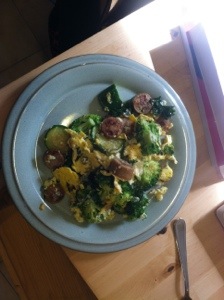
20140213-154203.jpg

breakfast of champions

My go-time breakfast meal is the scramble. The dish is super easy, consisting of chicken sausage or bacon, yellow squash and zucchini, broccoli, onions, tomatoes and mushrooms if I have them, with two brown eggs. Some pepper and garlic powder, maybe some turmeric to spice it up.

It leaves me full and very happy. In the midst of marathon training season, the scramble combined with a Clif Builders Bar (not shilling for them but they are fantastic) and a banana or some mixed nuts satisfies all the cravings.

It has come to the point where my body craves breakfast. If I don’t have breakfast, I feel it immediately.

Eating a complete breakfast daily is still a difficult task. Irregularities in the schedule make it difficult to get up at the same time every morning and after a tough shift the night before, the last thing I want to do at 8:45 is get up and chop up onions.

As much as I love the scrambles, I crave a little more variety. Being a creature of habit to the point of rigidity, it’s hard to break out and yet feel like I’ve had “breakfast.” For me, it’s not breakfast if I’m not having eggs in some capacity. Goofy, I know but hey, years of seeing those egg commercials paid off somehow from them!

Let’s talk: How do you spice up your breakfasts? Any ideas on variety?


30 Days of Good Food and how it helped change my life: The post script of #Whole30

First, I forgot to count down: Officially at 89 days to the Maratón!

Back in April, I completed the Whole 30 challenge. The Whole 30 Challenge is a part of the Whole 9 life, created by Dallas and Melissa Hartwig. The concept is simple: For 30 days, the goal is to eat good food and avoid types of food that cause damage to your body and cause unwanted and dangerous addictions. It’s about 30 days of intentionality, planning and purpose and ultimately, it’s you hitting the reset button and getting a fresh start.

To say that is helped change my life is not an understatement. It altered my relationship with food, what I eat, how I eat and the most important, why I eat. Close to three months in, habits that changed are still changing and I’m better for it.

But to get to that point, fellow air breathers, was a real challenge.

As a child, I wasn’t athletic but I was active. Childhood asthma stifled my ability to do many things, as did a complete lack of interest in playing high school football. (I did play junior varsity volleyball my freshman year. My position was left out.)

My family ate at fast food places often but my mother is a wonderful cook, so we ate well. I got to college and gained the freshman 15 like every other person but I was still active, so weight wasn’t a major issue in my mind.

I studied at Oxford during the fall of 2000 and while that was a life-changing experience, coming back to the States and to college was one of the worst times of my life. I struggled to re-insert back into the uniqueness of a Christian college sub-culture. My grades dropped because I wasn’t interested in my classes. I was madly in love with this woman and was convinced that we were ordained by God to be together and be married (sadly, that is not an exaggeration) but we broke up soon after I returned.

Thus, I gained about 45 pounds or so. I got to 225 lbs and stayed there, give or take 10 pounds, for about 11 years.

Coming out of the HOLE in fall 2012 and training for the half-marathon, I knew that I needed to eat better and make better choices about food. Mercifully, I was moving away from being the guy who started ‘Five Guys Fridays’ but that wasn’t getting to the root of my issues with food. If anything, I didn’t think I had any issues with food. I ate and that was that.

I had heard about the paleo lifestyle but didn’t know much about it. It seemed, well, weird and freakish and certainly not for me. I mean, the best dish I knew how to make was chicken and dressing. Here’s what’s in chicken and dressing:
chicken
sour cream
can of chicken and a can of mushroom soup
fake stuffing
mostly real Chinese noodles
very real butter on top.

I mean, seriously, a Caveman could make that.

Anyway, I found that the Paleo lifestyle wasn’t freakish (well, not that freakish) and actually, it’s pretty easy to implement. My friend M. at M = 1 (who is during her fourth #Whole30 this month and I’m so, so proud of her) told me about the grain manifesto, which led me to the #Whole30.

(As a side note, I won’t go through what the actual Whole30 challenge entails here. Click on the link at the top of this post to get all the details.)

Pretty much everything that is said will happen during the #whole30 did happen. It’s a not a big deal for the first two days, then your head starts to hurt. In particular, my head started to hurt because I eschewed coffee during my #whole30. That’s big. I’ve been a coffee drinker since I was 13 years old (again, no exaggeration) and giving that up for 30 days was the hardest by far.

After you get used to the hurting head, things become a bit foggy, almost dream-like. Then, you want to punch the universe in the face, followed by people that quickly come to mind. You get bored, then sick of eating leafy greens, then start to dream about coffee and milkshakes. Before you know it, you’re on the last week and it’s as if someone turned on a light and you begin to see things you haven’t fully recognized before. Your energy levels balance out, you sleep better and you FEEL better. And then, it’s 30 days.

In addition, these things were a big discovery for me:

I never thought more about food than during this time. Eating is an unconscious action. You think, “I want this.” So, you buy it and eat it. For the #whole30, this was the first time I had to think about every single thing I ate. What’s in this dish? What am I suppose to be looking for again? This has sugar. Does everything have sugar?

And thinking about food meant being mindful about food which meant giving a lot of attention to planning meals, figuring out where to shop, stopping to look at all the ingredients. It’s a lot of time and effort. For me, I was learning a new skill and really, that’s a bit embarrassing. I’m in my 30s and I don’t know how to shop for myself? Well, yeah.

It was one of the emotional experiences I’ve had. I’m a pretty emotional person by nature but I never equated emotions with food. Turns out that I’m an emotional eater and food has been a real comfort to me. It does make sense: After a long night in the newsroom, I’d stopped by 7-11 and get some candy bars. There’s candy everywhere (and I mean everywhere) in the newsroom. I’ve always had a strong stomach and could eat virtually anything and thus, I ate virtually everything. I ate when I was alone, I ate on my grand adventures, I ate in moments of sheer boredom.

Near the middle of the month, I started to recognize different emotions that came to the surface about many things that I had no clue were there. I felt anger at some things, disappointment and real hurt in others. Sadness over lost friendships, shame and regret and joy and delight that I just neglected to notice were present. Much of that was buried under my usage of food. And also me being a man, which leads to me to…

This is one of the most masculine things I’ve done. I posit that men have a different relationship with food than women. Men can (and often expected to) whatever they want and whatever fashion they prefer. Society frowns heavily on obese men and women but overweight men get a smile and possibly a joke or two, but that’s all. A man’s man is not one who likes his kale. It’s a man with BEER and BRATS. That’s a man who knows how to eat!

I always knew I was overweight and somewhat non-athletic and really took a bit of a perverse joy in that. I wasn’t “that guy.” Well, whoever “that guy” was, it wasn’t me and I made sure of that. I often was “the smart guy” or “the guy who does all these cool things” or “he’s such a nice guy but I’ll never date him” guy. But I sure as hell wasn’t “that guy.”

The truth was that I was scared. Terrified, even. What scared me wasn’t going on a diet or not eating dairy or exercising. It was taking responsibility. At this point, it didn’t matter how I gained the weight or what I ate. What mattered was that by going this road, I guaranteed the status quo, which was blissful failure.

However, if I succeeded in becoming physically fit, then that means active, not passive. Which means I do have control to make better decisions. Which means I’m not a victim or a martyr. Which means this is now and that was then and you have to let those 45 pounds go.

So, now they’re gone. And to celebrate…

Image

Training #2: Rhythming

First off, we are 99 days away from the Maratón!

Monday: 4.65 miles (4 mile plus strides), average pace 11:24
Thursday: 4.28 miles (3 miles steady, 1 mile fast), average pace 11:08, 9:48
Friday: Crossfit, Skill reps 5 rounds of Floor press (8 reps at 85 lbs), chest to bar pull-ups (5 reps at medium banding), banding good mornings (8 reps) Metcon: 125 simple jump ropes with handstand holds with broken reps

The key to this week was rhythm, finding it, staying with it and not getting led astray. This week was tougher with the Fourth and the start of a D.C. summer and also made tougher by an Egyptian revolution and me needing to get pro bono work done.

Finding a new rhythm is hard, easy and really hard. Once your heart and soul make a commitment to change paths and go in a new direction, it’s easy to get your legs moving. But then your mind (both your brain and your full essence) has to catch up and that is the hardest part of all. It seems like the brain is always lagging, busy playing host to anxiety and stress and always be mindful of what is unknown.

While I feel more settled in a new rhythm with paleo, running and CrossFit, my brain is seriously lagging in this whole process. Much of it is incredulous thinking (Seriously, a marathon in ARGENTINA? Couldn’t you have gone to Baltimore and been okay with it?) and my constant level of anxiety seeming to hit peak levels.

What is helping is a vision of crossing the finish line and while I’m almost done, thinking back at this whole process and knowing that it was worth it. Every early morning, every struggle and every anxious thought that is overcome. All of it.

Speaking of struggle, jump rope…uhhh, yeah. That needs work. The good news is that I’m now quite good at handstand holds. Silver lining, perhaps?

I need some inspiration…help me Johnny!


So a sorta Caveman went for a long run…

One of the challenges ahead on the road to good air is training for my first marathon while maintaining a Paleo lifestyle. Most of the research I’ve read is that it’s mostly doable, but a few adjustments will be needed as I get closer to October.

The biggest challenges I see are three-fold:

1. How do I get my carbs while keeping my fat-dominant eating template?

2. What to do about water, electrolytes and energy gels during the race?

3. Can I PLEEEEEEAAAASSSSEEEE eat Argentinian pasta when I finish the race?

Much of this is an experiment, so it’ll be lots of trial and error as I get to my long runs. I’ve gotten a lot better in getting my body to burn more fat in the front end instead of carbs and glycogen, but it’ll be a continued challenge as the training starts.

Got any advice and tips? Comments (especially the kind that are useful and from a real human with a real name) are welcome.

“The simple absence of grains or dairy or whathaveyou in stuff you eat doesn’t make it “Paleo”. A Paleo way of life is about choosing to partake in a “nutrient-dense life”, complete with deeply nourishing food, emotionally satisfying social relationships, and genuine interaction with the natural (i.e. outside) world. Embrace the spirit of the lifestyle instead of seeking ways to work around it. Relying on a blend of dried fruit and nuts isn’t “Paleo” – it’s just overeating trail mix. ”
-Dallas and Melissa Hartwig (Founders of Whole30 and Whole9)

This comes from Tom Denham, whose Whole Life Eating blog is an essential source of how to eat when I did the Whole30 Challenge.

And it shows that is truly appealing and necessary to the paleo lifestyle. It hasn’t been the changing of how I eat (although that has been crucial) that is been the monumental shift. It’s recognizing what really gives me energy and meaning in life. For too long, I took advantage of relationships and the joys of nature.