2/19: About 5 miles, about 9:00/mi 2/20: 9:33 miles, 9:12/mi 2/22: 8.03 miles, 8:10/mi 2/23: 20 miles, 9:55/mi
Total mileage: 42.33 miles
It didn’t take long to go from too cold to too hot.
The too hot is mostly my fault. I wanted too long to run my 20-miler on Sunday. It was a rare day off so I had grand plans to attend church before but that didn’t happen. My co-worker joined me for half that run and she did a great job.
Once I hit mile 12, I ran out of water. Conditions were sunny, about 60 but when you’re not used to sunny and 60, the body freaks out. Combined with the water fountains not on on the Mall yet (darn you sequester!), I was freaking out.
Mercifully, I got to the Mandarin Oriental, one of D.C.’s finest hotels. Snuck in the front door, headed straightaway toward the water fountain and CHUGGED. Two busboys came by, asking if I was okay. Oh, I’m doing just great, I responded.
I must say, the water there was fantastic. Maybe because I was dehydrated and starting to deal with mild heatstroke but damn, that water was impressive!
The heat and lack of hydration slowed me down and by mile 18, I was hurting. My phone was about to die but I forced myself to make it home. It hurt but it was worth it.
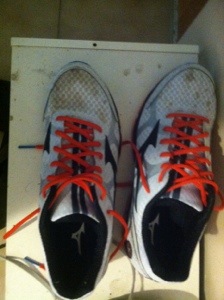
The tendons on the top of my feet cooperated on the 20-miler, unlike the other runs earlier this week. I think it has to do with my changing my shoes and my feet getting used to new laces and such. Years of wearing ill-fitting shoes (not because of style but because of laziness and a lack of knowledge on my part) cause perpetual sensitivity with the top of my feet. It flares up from time to time and came back with a vengeance this week. A change in how I laced my shoes did the trick and I’m hoping it stays this week. We have about 3 weeks to go until Rock and Roll and I feel good. Tapering begins next week and I hope to maintain the fast pace when everything is going well.
This week, it’s cold, again. Winter makes one last push before exiting, stage left. Finally.
Passed by Nats Park during the 20-miler. It’s empty now but won’t be in about 6 weeks. Baseball is almost here!!!
Growing up, we Plunketts were a fast food family.
In fact, one of our hallowed religious traditions involves fast food.
At one point, we lived six houses from Taco Bell and running for the border was a favored pastime. One Easter, we were low on funds and time, so we went off to Taco Bell for a quick Easter lunch. We were the only people in the restaurant but it was one of our better Easter lunches. Our family maintained that tradition for many years. It’s a good reminder of how things were and the constant renewal of life.
My mother is a great cook. Self-taught, she figured out how to make fantastic pasta dishes and her chicken enchiladas and albondigas soup is to die for. Whenever she could cook dinner, she will. Even now, weeks before I’m set to arrive for a visit west, my mother texts to ask what I want to eat while I’m staying with my parents.
Dad is an expert omelet-flipper. Really, it’s pretty impressive. I have yet to master that skill; hence the constant scrambles for breakfast.
Sometimes (actually, it was every and often), he mixed up his spices, putting poultry seasoning on toast and putting ginger on well, everything. He’s also a fan of chocolate pudding and potato chips, together. In one bite.
Otherwise, we ate fast food, a lot. Both my parents worked long hours in our middle-middle class upbringing in the quintessential suburban neighborhood in California, which predicated on lots and lots of fast food.
The High School Athletic Wall of Fame is located at the McDonald’s on Woodruff and Del Amo. Allegedly, One of the first McDonald’s is up Lakewood Avenue in Downey, it’s art deco signage still in use.
After church on Sundays and youth services on Wednesdays, my friends and I were either at Taco Bell, In ‘N Out (God Bless the Double Double!) or Fuddruckers. Our pastor’s signature line to encourage fellowship was, “Now, everyone go out and have a cheeseburger!” We Evangelicals were big into literalism, so cheeseburgers it was.
Mind you, this is the 90s, before Starbucks went public and the coffee shops started popping up all over the place. In college, our group was at the Buck or the “holy sanctum” of coffee, Coffee Bean and Tea Leaf (I’ll provide the sacred and profane sermon regarding coffee shops another time).
Nevertheless, it was fast food that ruled the day.
I write the above noting that fast food restaurants have changed and continue to evolve. This was before Fast Food Nation, Food Inc and much of our growth in food awareness. Anyone who was a vegetarian, a vegan or god forbid, trying a paleo diet would have gotten stares or in the case of my childhood, the verses in Scripture about how it’s perfectly acceptable (thus Biblically mandated) to eat meat.
Also, it’s an indictment against our consumer industrial complex and how much of the fast food industry disenfranchises the poor, who can only afford fast food to get through the day. While it’s “cheaper” than most food, you don’t truly know how your food is made or produced. While it’s a good starting job for those entering the work force, it bumps corporate profits at the expense of employee health and well being.
What I want to focus on is process, specifically, the joy of cooking your own food.
Apropo of nothing, hot dogs are a delicacy in Chile. This was lunch one day in Santiago. And I wanted a photo of hot dogs in this post.
For years, food preparation was a necessary evil
My cooking skills are elementary. My spaghetti sauce is well known among the circle of friends and former roommates. The Plunkett specialty is chicken and dressing. Chicken and dressing consists of chicken, sour cream, cream of chicken, dressing and Chinese noodles. Add butter, lots of butter, and there was the best I offer, food-wise.
The night work schedule added to the lack of time and convenience to cook. Partly my desire to get out of the newsroom for any moment (Rule #1 to work: Leave as often as possible!), it was a stop for fast food. In downtown, D.C. the options were Subway, pizza that is nothing close to being authentic, Cosi and Five Guys.
Fridays were reserved for Five Guys, so I ate fresh often. As you can see, my eating patterns weren’t the gold standard of healthy eating. My eating consisted of about 20% of my own cooking and 80% of eating out.
Everyone has his/her own reasons for how they eat and what they eat. In my instance, fast food was convenient but more so; it was a comfort and perhaps a sense of security. It buffers against the stress of the job and provided a sense of a home from which I am far away. Fast food also was an opt-out against a deep-rooted fear, the inability to take care of myself. I’m on my own and have grown past the typical bachelor stereotype of empty pizza boxes in the corner. (Now, it’s empty Whole Foods bags in the corner but I digress.) Too often, I allowed that perception to rule my life. If I don’t have anyone else to cook for, which should I put in the time and effort? No one is going to care, so why should I?
The biggest change in switching out was changing the default mode. As the majority of food decisions are automatic and semi-conscious, it takes mindful effort to adjust the process of eating. For me, it was addressing those fears head-on.
Three Christmases ago, my parents gave me Mark Bittman’s How to Cook Everything. That book saved my bacon. Two Christmases ago, my parents also got me a slow cooker and that has been my faithful friend and companion.
One of the first meals I made. Slow-cooked pork and a kale dish that includes cashews, onions and cranberries. ENDORSE.
Now, I own a cask-iron skillet, a Dutch oven, some pots and pans and a steady stream of olive and coconut oils, cumin and pepper. While I enjoy a fine dining experience now and then, my food passions reside in finding hole in the walls and unlikely spots, a la Fast Gourmet (which was a heartbreak in not eating there multiple times a week).
Cooking is still a process, with bits of enjoyment and pleasure. Mostly, I appreciate the chance to make something I know I’ll enjoy. Fast, well, faster food is still an ongoing issue. It’s come to the point where the food ratio has flipped: I cook about 80% of my own food and eat out about 20% of the time.
To this day, I still eat Taco Bell for Easter lunch. It’s the only time in the year I’ll eat Taco Bell. As an adult, the tradition means more to me now than the food.
Sometimes, it takes a 99-cent burrito to celebrate renewal.
Let’s talk: How much does fast food dictate your eating habits? Is it a joy or a struggle? And any great fast food options that are healthy?
About a foot of snow fell this past week in D.C., the most since Snowmeggedon four years ago. Temperatures are above freezing, which is good but Old Man Winter is making his final push before we start to move to spring.
Sunday’s run was awful. The running app wasn’t functioning, I slipped on ice and almost face-planted. I re-injured my right foot and to top it off, my phone died and I forgot my wallet. So, it’s walking three miles home.
I’m hoping a few days’ rest and some RICE (rest, ice, compression, elevation) will do the trick. We’re at t-minus a month or so before D.C. Rock and Roll. My times have been good and I’ve been running the best I’ve ever ran. Perhaps the over-exertion got the best of me this week. That and trying to avoid all the tourists in town for President’s Day weekend didn’t help.
My Wave for runners are great for running, bad for mud. Very bad for mud.
Speaking of my shoes, they got broken in nice and good. What I thought was a shortcut to get by the Capital pond was just mud, ice and a near face plant on the grass. The battle scars are a nice touch but to avoid continued pain with the tendons on top of my foot, I need to figure out a better way to lace these bad boys up.
Talk back: Any tips or methods to lace the shoes so they don’t exert direct pressure on the top of my feet?
This world is full of conflicts and full of things that cannot be reconciled but there are moments when we can transcend the dualistic system and reconcile and embrace the whole mess, and that’s what I mean by ‘Hallelujah.’ That regardless of what the impossibility of the situation is, there is a moment when you open your mouth and you throw open your arms and you embrace the things and just say, ‘Hallelujah! Blessed is the name…’
The only moment that you can live here comfortably in these absolutely irreconcilable conflicts is in this moment when you embrace it all and you say, ‘Look, I don’t understand a fucking thing at all–Hallelujah’ That’s the only moment we live here fully as human beings.”
The quote is from Leonard Cohen, speaking about his famous song, “Hallelujah.” I’ve been reading Alan LIght’s The Holy or the Broken, a history on that song. For years, it languished in obscurity: Columbia Records didn’t release Cohen’s album with that song and most people who heard the song (or in the case of Jeff Buckley, initially sung the song) didn’t know that Cohen was the writer.
Cohen is a poet by trade, and a damn good one at that. He summarizes my feeble attempt at explaining my current state of things better than I ever could. Cohen’s “Hallelujah” deals with spiritual resignation and irony but ends with a tone of hopeful triumph that other versions of the song leave out. “Even though it all went wrong/I’ll stand before the Lord of Song/With nothing on my tongue but Hallelujah.”
Note: I’m coming close to one year of switching over the paleo food template. Amazingly enough, it’s stuck and really become a life-long mindset. These posts deal with how I got here and how my life has changed.
For years, I didn’t eat breakfast. Because of a second-shift job, my breakfast was usually lunch.
If I was up for breakfast, it was donuts. Lots of donuts. And coffee with cream and sugar. That was it: Sugary, creamy coffee and donuts. One would think I was a cop but I was a journalist (a far worse predicament).
I always heard that breakfast was the most important meal of the day. I never believed it. When my energy levels were low for the day and I required more and more sugar to keep going, I didn’t give a second thought to how I ate. I just ate. That, combined with a stressful job in a stressful city, leads to major problems.
I can’t tell you how many boxes of Pepto Bismol I’ve consumed. The stomach-aches, lethargy, continue struggles with acne and being overweight, all constants for most of my late 20s and early 30s. It was a given that after eating wheat, my throat would seem to close in, making it difficult to breathe and swallow. This would last a few minutes before I would finish eating whatever pasta or burritos I purchased.
A week after starting at the Post in summer 2010, my body was in extreme pain. After checking into the emergency room for fear of appendicitis, the doctors asked me about my high blood pressure and struggles with digestive issues.
Look, I just started a new job after months of unemployment; of course I have high blood pressure! I joked the doctors. I was fine but they told me to think seriously about changing my diet.
I didn’t. I walked home because I didn’t want to pay for a cab. I didn’t have any money and because my new health insurance hadn’t kicked in, it would be some time before I had money again (and that’s worth multiple posts but I’ll leave that for another time).
It wasn’t those issues that began the change. For me, it was staring in the mirror that I realized something: I don’t look the way I feel. When I had energy, felt alive, I saw one version of myself. But what was staring back at me was another version. It was that disconnect that was a trigger for needed change. I wanted my outside to match how I felt on the inside.
The Whole30 challenge was the first time I had to think about eating and how I felt about it. One of the biggest realizations was I wasn’t giving myself the right tools to start and complete the day the way I wanted. Much of my concern was about time. I didn’t have enough time to make breakfast, sit down and eat it, then go about the business of the day. The issue was that I didn’t make time for it. More so, I didn’t want to make time for it.
It was difficult at first. Making breakfast means getting up earlier or accepting that getting up late means time is lost on the back end. That mean going to bed earlier, which meant stopped the caffeine intake earlier the previous day, which meant eating breakfast earlier the previous day.
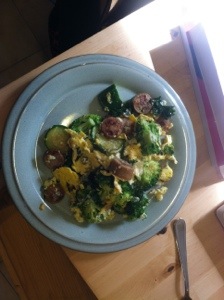
breakfast of champions
My go-time breakfast meal is the scramble. The dish is super easy, consisting of chicken sausage or bacon, yellow squash and zucchini, broccoli, onions, tomatoes and mushrooms if I have them, with two brown eggs. Some pepper and garlic powder, maybe some turmeric to spice it up.
It leaves me full and very happy. In the midst of marathon training season, the scramble combined with a Clif Builders Bar (not shilling for them but they are fantastic) and a banana or some mixed nuts satisfies all the cravings.
It has come to the point where my body craves breakfast. If I don’t have breakfast, I feel it immediately.
Eating a complete breakfast daily is still a difficult task. Irregularities in the schedule make it difficult to get up at the same time every morning and after a tough shift the night before, the last thing I want to do at 8:45 is get up and chop up onions.
As much as I love the scrambles, I crave a little more variety. Being a creature of habit to the point of rigidity, it’s hard to break out and yet feel like I’ve had “breakfast.” For me, it’s not breakfast if I’m not having eggs in some capacity. Goofy, I know but hey, years of seeing those egg commercials paid off somehow from them!
Let’s talk: How do you spice up your breakfasts? Any ideas on variety?
Feb 4: 5.02 miles, avg 9:19/mi Feb 5: 6:85 miles, avg: 9:18/mi Feb 7: 8.01 miles, avg: 8:25/mi Feb 8: 18.01 miles, avg: 9:11/mi
Winter is a good time to keep still. Stillness is the default measure. The world longs to be barren for a season. Give it a rest, let the winds blow before it’s time to grow again.
Winter makes running a challenge. In a way, it becomes the real marathon. Contending with the forces of nature while preparing for a race leaves windblown eyes, a constant runny nose and more problems trying to take a breath.
This winter has been the most active in my nearly six years in the District. Multiple polar vortexes, goofy snow storms and lots of wind has made training quite the challenge.
But it’s working. I’m getting faster, averaging close to 9 minutes per mile and feel more confident about keeping that pace throughout the course of the entire race.
We start what I call the summit: three weeks of heavy running. Nearly 40 miles a week and the long Saturday runs. I hit 18 miles this past Saturday and while I retired my Buenos Aires shoes and my feet are still sore as hell, it went well.
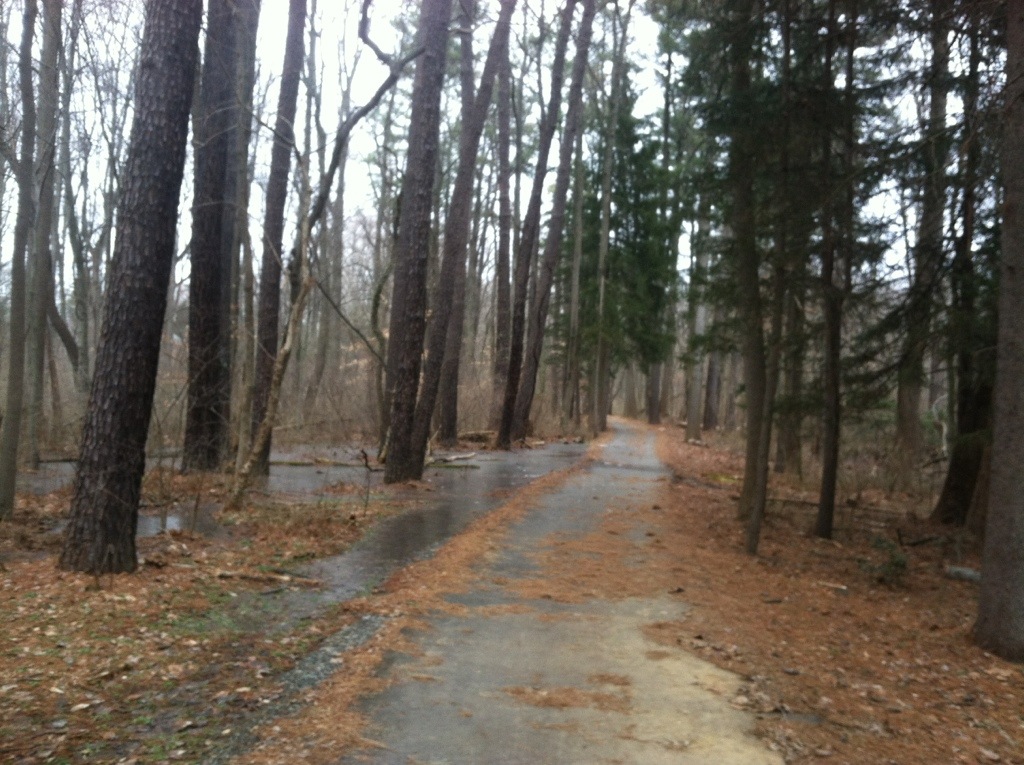
Rock Creek Trail, straight out of a scene from “The Road.”
I knew I hadn’t updated the blog in some time but this is ridiculous. I assure you that I’ve been quite busy, running and other such things.
But first: It’s a new year! The new year always seems to be a mixed bag. It’s a chance to start over, make changes, keep things the same. However, it’s January. And that means it’s cold.
The District has been accustomed to warmer winters the past few years. Not this go-around. Last Tuesday, it felt like 10 below. Yesterday, it was 60. I seriously don’t get it.
No matter. D.C. Rock and Roll is a still a go. The training bumps up from three to four days, with the long runs starting to get longer. I partied a little too much Saturday night, so it took some time to get going on the Sunday long run.
I felt great. The weather was warm but not too warm, slightly breezy but not too windy. The first 10 miles were a breeze (yes, that pun is intended).
Miles 11-14 were a challenge. That’s to be expected and welcomed. The point of training isn’t for the first miles but rather the last. I run to develop endurance to finish. In training for the maratón, a friend told me that the marathon is really a 20-mile warmup to the last six miles.
Generally, I’m getting faster in my running. I average a 9-minute mile, which is about a full minute faster than my average last time. I feel stronger and more confident. Averaging 9 minutes is my goal for D.C., with the ultimate objective to get a close to completing the marathon in four hours. My time in Buenos Aires was close to five hours and that was taking in all the sights and experiences of the trip.
D.C. is home turf and with my best friend coming up to run, we’re coming to race.
The next 6-8 weeks are the real gauntlet with training, so it’s time to buckle down for the long haul.
December 4 Crossfit Back squats (up to 115), climb rope, metcon: 4 rounds, 45 sec/15 sec rest, knees to elbow chinups, ball slam (40lbs), split squat jumps Total: 143
December 6: 4 miles, avg 9:51/mile
December 7: 10.03 miles, avg 9:00/mile
Today (December 10), I woke up to this:
It was beautiful but like all D.C.-related storms, it was fleeting.
Nevertheless, I was thankful for 70 degrees a few weeks back.
Yes, I was thankful for family and friends, old haunts and new finds. I was grateful for a decent rental car, even though it took me nearly two hours to pick it up. I was happy about LACMA and the Farmer’s Market on Fairfax and even happier for long-known friends who are married, pregnant and delivered.
My two sisters, my future brother in law and his cousin and me.
Then, I got back to D.C. and it was cold. And cold it will stay.
Training for marathon #2 officially commences and it’s home turf. I ran the rock and roll half-marathon this past March and it’s a real marker in terms of my own physically and life development. This time last year, I was beginning the training for that race and everything seemed to be at stake. In a sense, it was.
It’s a little different this time, but not by much. Greg, one of my best friends and one of the initial people to get me into running, is coming up from Missouri to run this race. For both of us, it’ll be a great time seeing this great city in a different perspective.
Trust me, it was in a great location in Palermo. The area was fashionable and trendy, the result of Argentines opening up shops to showcase hobbies after the 2002 crisis. Property was cheap and no one had a job, so sell what you know. Winning hobbies became profitable business.
Sundays are for family and asada. It was cool but not cold. Sunny but not hot. Spring. Again. Parks were filled and people were happy.
We were happy. Thrilled. Ecstatic. All of the above.
We window-shopped and talked, then had burgers and beer. We marveled at what had happened. We met this person and this person and saw this and saw that. I was sore but wasn’t in real pain. My dad’s head was sun burnt. We didn’t care. The race was won.
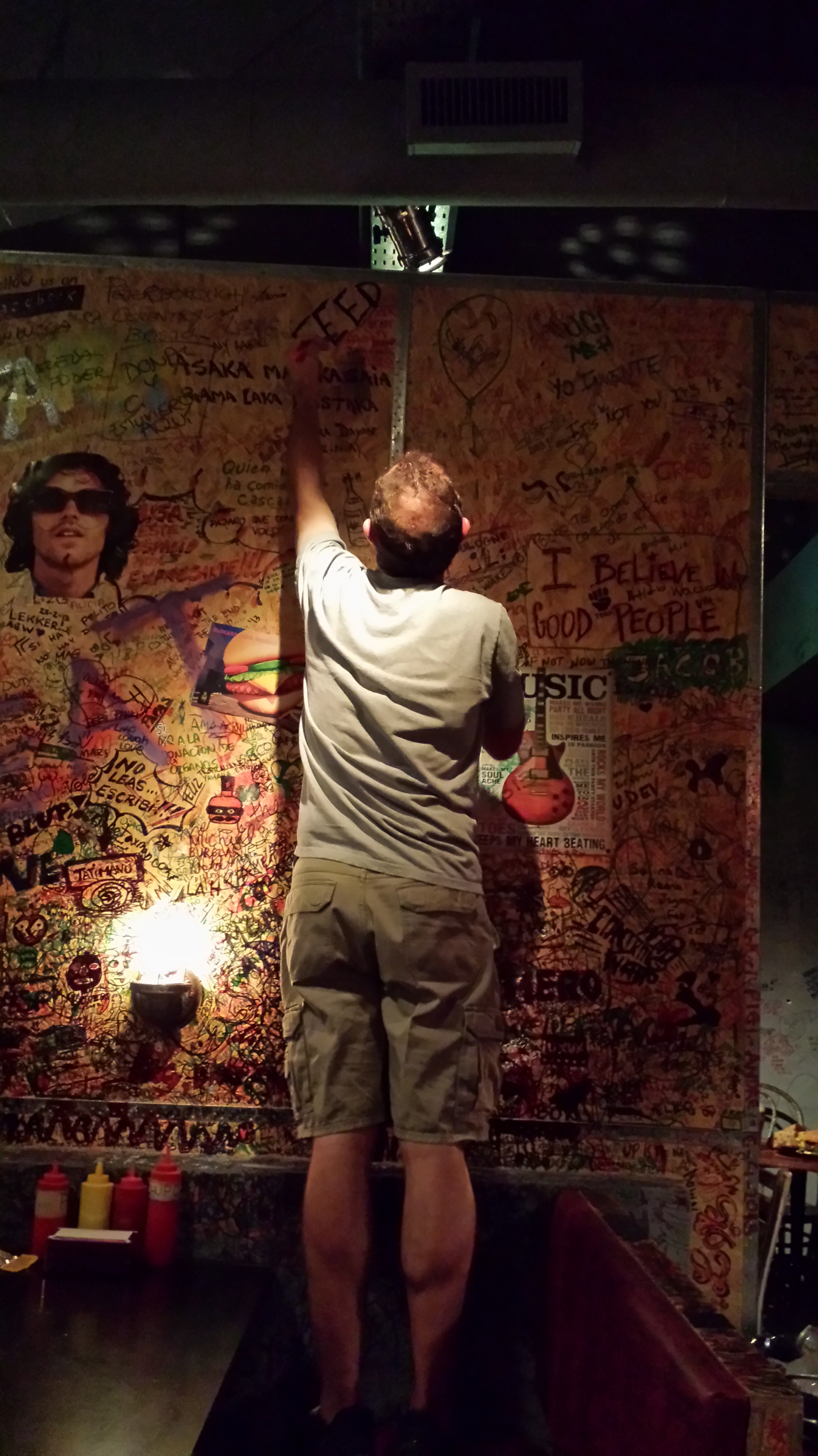
We were here. Look for us on the wall. Burger Joint, Jorge Luis Borges, Buenos Aires
If you go to the Burger Joint on Jorge Luis Borges, sit at the booth opposite the “Que Ves?” mirror. Look up at the wall and with luck, you’ll see the following: 42K Start to Finish. Jerry and Mike, Buenos Aires, October 13, 2013.
***
We were tourists in Buenos Aires for one last day and the morning after. By this point, we finally figured out the directions of the city, finally figured out the timing and luckily found someone who spoke English at the grocery store. The sushi was fantastic and Café Tortoni was lovely. Vintage. Old-school class, a party amid the crises.
The rest of our time was in Mendoza and Santiago de Chile, both wonderful places to visit. There are stories to be told and someday will be told but for our purposes here, believe me when I say we had a magnificent time. Wine, absinthe, the Andes, Paseo Huérfanos and Bellavista, Valparaiso.
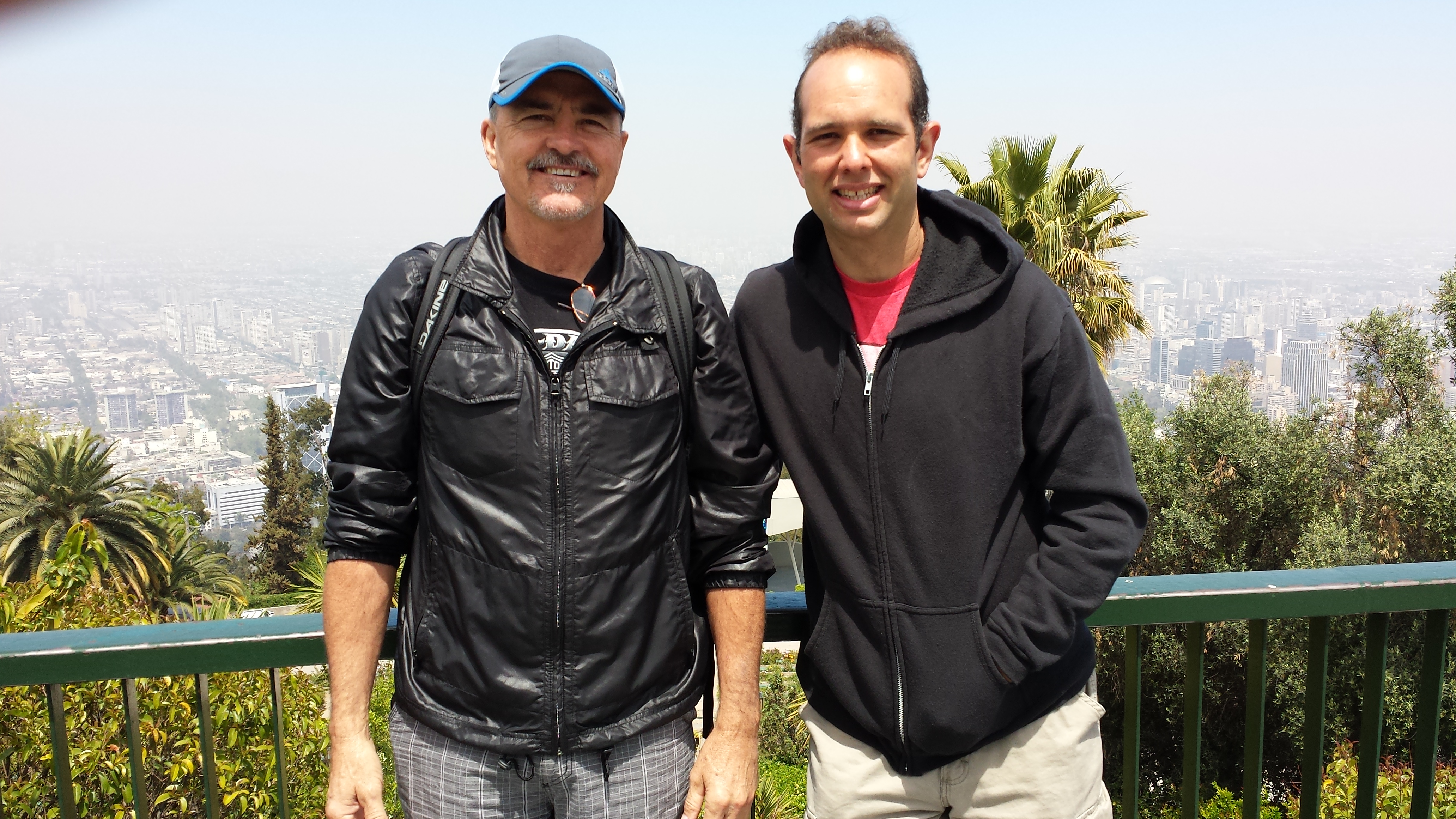
Atop Cerro San Cristobal.
Dad and I cleared Chilean customs with time to spare, so we sat at Ruby Tuesday’s and tried to process our time together and the end of this adventure. We laughed about the Argentine at the parrilla in Mendoza, who kept getting friendlier as he drank. We exchanged thoughts of bad Mexican food (don’t eat the Mexican food in Santiago) and Taco Bell, which surprisingly was good. We thought about Plaza de Armas, Pablo Neruda’s house and still tried to figure out we scored on the apartment in Santiago.
So Dad. This went so well, I’m thinking about trying for another continent. Berlin. The Great Wall. What do you say?
Dad laughs.
I’m serious.
I know you are. That’s why I’m laughing.
Well, we can let the adventure continue!
Well, let me pay off this adventure first.
We embraced and went home, he to L.A. and me to D.C.
***
November 11: 6:28km, 5:23/km
November 13: 7.84km, avg, 6:12/km
November 14 CrossFit:
Mobility (Circle of Death, in which each person comes up with a warm-up exercise as go around the circle. Thus: two burpees, 10 jumping jacks, five squats, five pushups, five situps, five burpees, 10 split squats).
Deadlift 5×5: Got to 145 pounds
Assistance 3:10: Alternate false grip row and L-sit positioning
Conditioning: outside run, medicine ball relay
I woke up late and almost didn’t make it CrossFit. I struggled at first but running outside invigorated me.
The air was crisp. We’re back to autumn again. The past two days were a foreshadowing of winter. Running yesterday was a near-nightmare. I have to remember to wear gloves.
Just like that, it’s coming toward the end of the year.
What a year.
The time ahead is open and uncertain but what is for sure is the road to good air continues. I aim to talk about issues of health and fitness, upcoming changes and what’s next for the celebration of the Jesus Year.
I’ve already signed up for the D.C. Rock and Roll marathon next March. I ran the D.C. half-marathon this past spring, so it’ll be wonderful to run this race in one of the best cities in the world.
Thanks for reading.
***
Speaking of it being quite the year, here’s a sense of before and after.
What a year a difference makes.
That’s me at my friend’s wedding after this time last year. On the right, that’s me now.
In terms of numbers, I went from 232 pounds to 172. Pant size shrunk from a size 38 to a 32. I went from a X-large to medium.
More so, I feel healthy. I am healthy and on the road to becoming healthier. That’s what important.
It’s a long road, filled with challenges but also filled with opportunity.
Note: I’m finally finishing up these blogs, weeks after returning from South America. Part of it was that our trip was so jam-packed that it was exhausting to write coherent blog posts as we traveled. Another part of it is that I’m in denial that the trip is over. So, these blogs become a way to document and remember one of the most fulfilling experiences of my life so far.
First, some theme music.
Chariots of Fire is my all-time favorite movie and on the night before both races, I always play the Chariots of Fire theme song. Please enjoy as preparation for reading this post.
5:00 a.m.
I couldn’t sleep. Too nervous. The puttanesca from last night was at war with my stomach. That made me more nervous.
Alarm goes off. I get up. Shower, put on running clothes and triple-check with grab bag. Tie and re-tie my shoes. Is my CHIP on correctly? Yes, it is. Stop worrying about it.
5:45 a.m. Phone rings. An annoyed man on the other line says something about a taxi and says my name. At this point, I’m not going to bother trying to figure out what he’s saying. I say OK. He repeats himself, speaking much quicker. OK. He hangs up.
Dad comes out of his room. Everything okay?
Yes, it is. I’ll see you in a bit.
I go outside to wait. I’m officially on the clock.
***
The Buenos Aires marathon began in the spring of 1984, although the city counts a marathon held in 1903 as the first modern race in Argentina. Buenos Aires hosted numerous competitions and games in the 20th century and has cultivated a strong passion for long distance running from the 1970s onward.
Aside from 2002 (the year of the economic crisis), a marathon has occurred in the city every year. In 2003, the marathon reconstituted with new sponsors and a new route with 900 runners. Since then, it rapidly grew to become South America’s largest marathon, with 8,000 runners in this year’s edition. (It was reported that close to 9,000 ran, which wouldn’t surprise me.)
Much of the appeal of the maratón is the route. The city is flat, with a decent coastal breeze coming for the majority of the route. Spring brings cooler temperatures but more so, low humidity. With the exception of dust and pollen, this is the perfect time to run in BA.
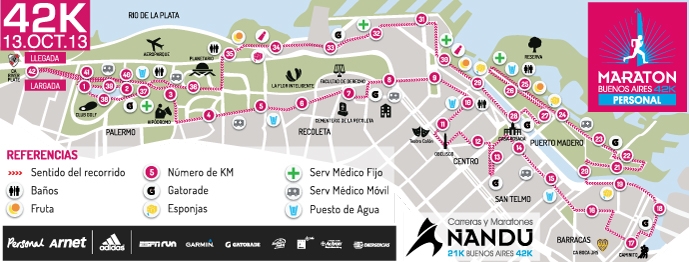
Map of the Buenos Aires marathon
The route is mostly a loop through the entire city. The start and finish line are on the tip of the Belgrano neighborhood. From the start, runners pass through Palmero and Recoleta, then hit the main highway to turn onto the city center. From there, runners traversed through alleys and side streets to get to Avenida 9 de Julio (the widest avenue in the world), Plaza de Mayo and the San Telmo and Las Bocas neighborhood on the south end of the city.
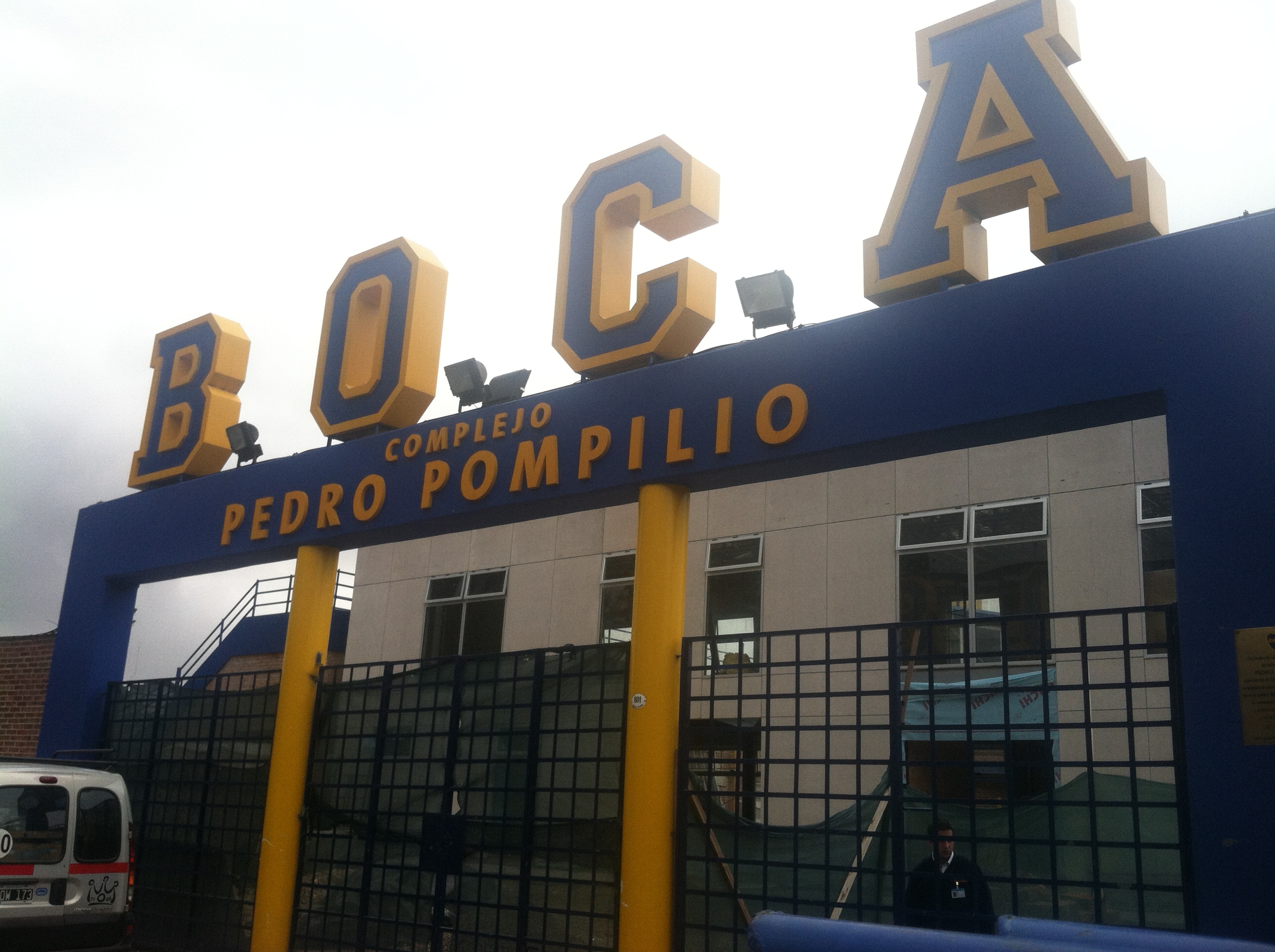
One of the highlights: The famed Boca stadium in the La Bocas neighborhood.
Runners make a turn toward the ports, go through Puerto Madero and the ecological reservoir then head up Avenida Figueroa Alcorta, taking a last run around the lake to the finish.
***
6:00 a.m.
I head out to wait outside the apartment complex. Party goers are heading back to wherever they came from. Taxis filled with one-day lovers finishing their make out sessions breeze through the streets.
No taxi for me.
The day before, Dad and I rode to the starting line to watch the preparation and get a sense of time and distance. From our calculations, it was about 5k from where we were in Palmero to the starting line.
I gave myself until 6:15 to decide to wait or start walking/running. A taxi would come by, then speed off. Another one. Then another one.
At 6:10, the street went silent. The sun was starting to come up.
Alright, Plunkett, time to walk?
Shit. This is going to suck.
***
There has been one pressing thought that has haunted me for most of my training. It wasn’t how well I was going to do. It wasn’t how I was going to smuggle in my Hammer energy gels into Argentina or which compression socks to wear.
It was: How was I going to get there?
I don’t mean getting to Argentina or Buenos Aires, but the corner of Avenida Figueroa Alcorta y Monroe. This corner was the start/finish line for the marathon. And this corner has been on my mind for months.
The metaphorical thoughts aside, I really stressed about how the hell I was going to physically get there. Here’s why: The race was Sunday morning at 7:30 a.m, which meant the Subté (the metro line) wasn’t open. Buses were running but street closures began the night before and the route diversions could leave me farther away from where I needed to be. That leaves walking or running or get a taxi.
Everything I had read about taxis in Buenos Aires boiled down to two things, most of which was the taxi force was a mafia and they are known for screwing over foreigners. If you don’t know Spanish, well, pay attention, look at the pesos and watch the driver’s eyes at all times.
Good. God.
As you can see, this was weighing on my mind. This last 5k of getting to the damn race became the claw in my brain.
The recommendation was to call a taxi company the night before and make a reservation. I’m going to skip over the conversation but it involved being hung up twice, having the taxi dispatcher yell at me in the fastest variation of Spanish I’ve ever heard and me saying my address five times because I didn’t know what else to say.
Nevertheless, the reservation was made and I attempted to go to bed. By attempted, I was as nervous as I’ve ever been. Hell, that doesn’t even begin to explain it.
I had made it this far and I sure as hell wasn’t going to be derailed by some taxi mafia. Even if it meant I ran another 5k for the hell for it, this was going to happen. I’d come too far to be stopped by this, right?
Right?
***
6:14 a.m.
I turn to walk but look at the street one last time. Coming from the west were two people.They are dressed in running garb.
This is a possibility.
I check for the white tote bags from the marathon. They have them!
I call out, señor, señorita!
They look around, not sure who’s talking to them. I call out again. I hold out my bag and anxiously ask.
Maratón?
Ah, sí!
Taxi or walk?
Oh, we’re taking a taxi.
They speak English.
I exhale and beg to go with them.
Of course, of course.
***
At the 19th kilometer, I nearly slipped on a banana peel.
The fact that the marathon offered fruit in addition to Gatorade and water was a welcome addition. Everything about this race was well-organized and well-done. The bag drop, long a source of tension and frustration for runners, was easy to find and easier to get the checked gear once the race was done.
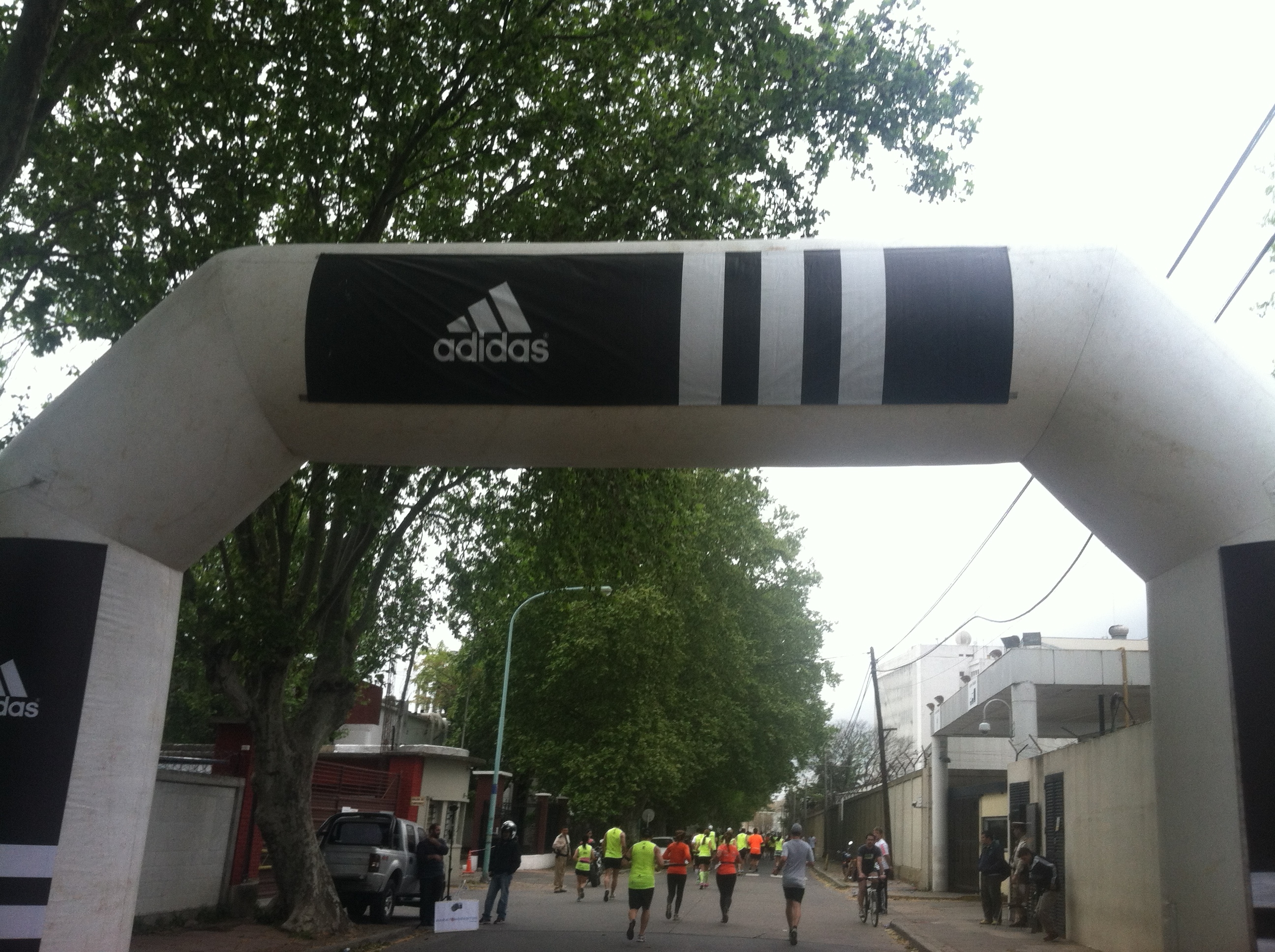
The half-way mark, sponsored by Adidas.
All the kilometer markers were easily identifiable and the staff was very nice and professional. The military helped out with security, which was quite odd at first to see but they seemed to blend in.
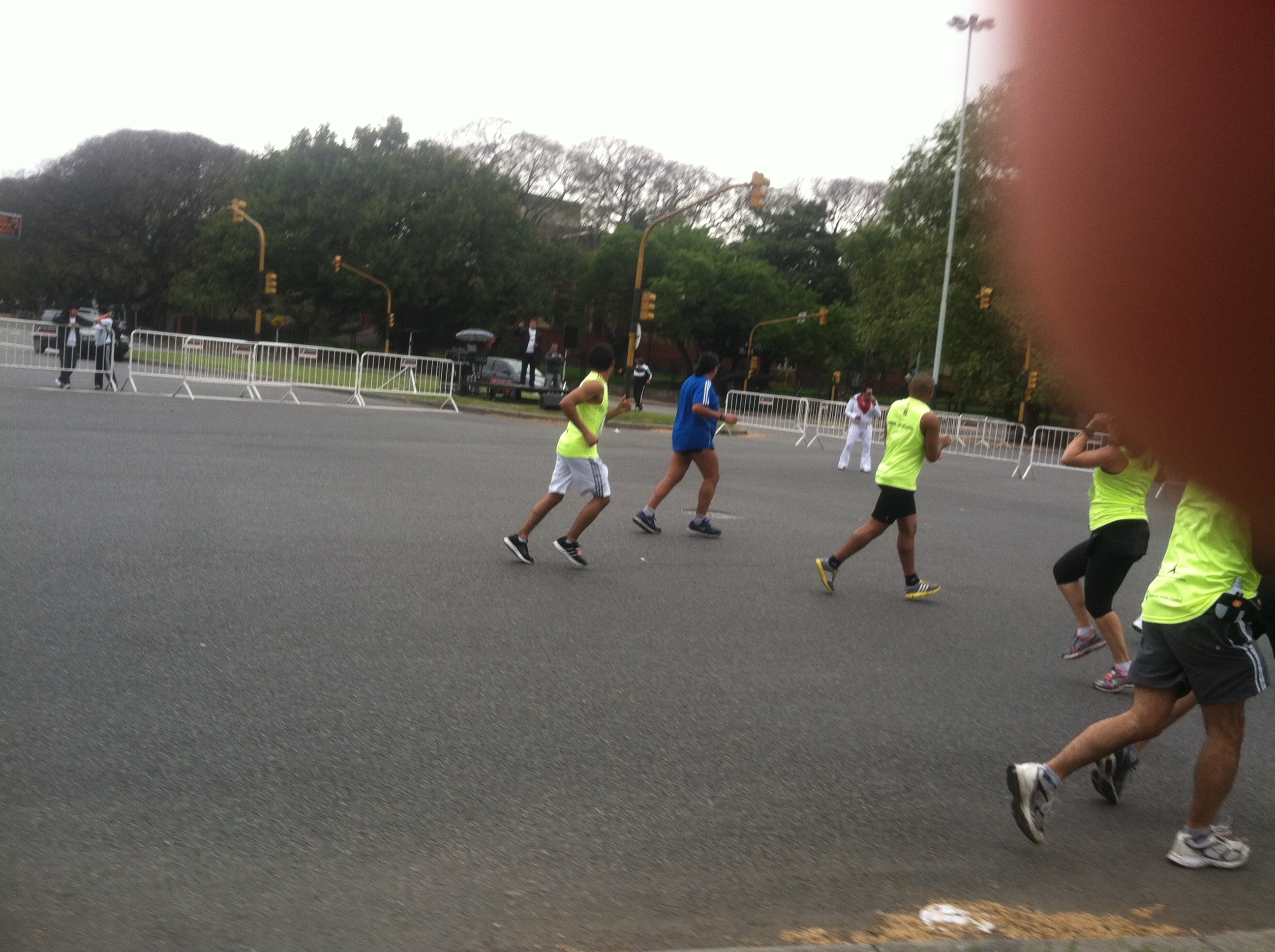
There was even entertainment. A couple dances the tango, a great Elvis impersonator and an even better Michael Jackson impersonator as we crossed the Plaza de Mayo. It helped with the running.
Hard to see (and pardon my thumb) but there’s Elvis (this is leisure suit Elvis.)
I was about 2.5 hours behind the winning group, so when I got my fruit and water, the road was littered, and I mean littered, with banana and orange peels.
I did slide. Twice. Luckily, I didn’t fall. In fact, I didn’t struggle much during the race. No joint problems and no blisters to speak about. I had minor aches and pains (and a sore left ankle that was a minor annoyance the rest of the trip) but that was it.
Although, slipping on a banana peel would have made for a great story…
***
6:17 a.m.
The couple was Marcelle and his wife Medira from Saö Paulo, Brazil. This was their second marathon in Buenos Aires and they assured me this was a wonderful course.
We headed to Plaza Sarimento to get a taxi. After we were refused twice and another driver told the hot Argentine instead of us (to which Marcelle and Medira mocked with impunity. I can attest that the tensions between Brazilians and Argentines is very real), we finally got a driver and headed over.
A few street diversions later, we made it near the starting line. They paid (and insisted I didn’t pay, which was beyond generous) and we parted, they to their running group and me toward the starting line.
The best of luck to you in your race, Mike.
For what I struggled with and lamented as my biggest obstacle, God had gone before me and put in its place comfort and joy.
***
Speaking of entertainment, I met some of the best people along the way.
Luigi and Giancarlo were older gentlemen from Italy. I knew they were from Italy because they told everyone they were from Italy. Plus, it was also on their running t-shirts.
They stopped at every tourist spot and took a picture. It was a testament to how fast they were running (and how slow I was going) they we stuck together for nearly half the race.
Coming along to three-quarters of the race, I kept hearing some yell at the staff. What’s that all about? I finally spotted the runner, a gregarious fellow wearing a Venezuela shirt.
I gotta go talk to him.
His name was Fidel and what he was doing was asking the beautiful female staffers to cheer louder for him as he passed by. One successful, he pledged his love and fidelity (yup, that’s very punny of me!) to each of them. For Venezuelans, there’s plenty of love to go along.
In my broken Spanish, I tell him I’m half-Venezuelan, visited Caracas with my biological father in 1999 and wanted to go back. He was thrilled and in his broken English told me how the city has changed post-Chavez and the hope for the future.
He, like me, ran to finish.
There were Chileans (Chi-Chi-Ch-le-le-le!) and Brazilians. Lots of choruses of sí, sé puede! I thought I saw a few Australian flags on t-shirts. All in all, it was a sea of yellow and us who choose not to wear the official shirt.
But I kept wondering: Where’s Dad?
***
7:00 a.m.
From this point, time is starting to speed up. Runners everywhere, stretching, jogging, laughing with cohorts. Long, long lines to the bathroom, which was a clear indication of the elite runners and everyone else. Everyone else (me included) waits, takes a breath and hopes for the best.
The elite go wherever they can. And I’ll leave it at that.
I see four women with USA and American flags on their shirts.
I called out, Amerícanos!
They look at me.
I ask, where are you guys from?
Oh my god, you’re American! We thought we were the only ones here.
Just before we parted, the lead woman said when I called out for them, she was afraid I was going to throw shit at them.
New Yorkers.
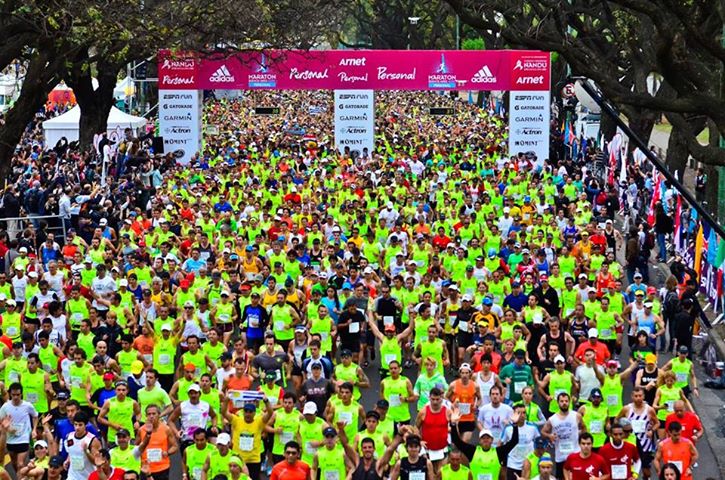
Announcers were on the microphone and runners hustled to get into line. A few more stretches in and I was in place. From my vantage point, it didn’t seem like a large crowd. As you can tell from the photo, that’s not the case.
8,000 people on their way. (Photo courtesy of the marathon staff).
Crowds are cheering, lights from the ESPN station are glaring onto the first competitors ready to start. The countdown begins: diez, nueve, ocho…
It catches me by surprise. After all this, it starts now.
***
The back-end of the marathon was a long stretch through the ports. Miles and miles of open space. The sun was out, the running crowds thinning. It was the spot of the race where the drag kicks on.
Energy starts to wear, the iPod playlists start over. The finish line a ways away but it’s too far to start over. The only way out is through.
The long stretch of the Ports
I’m moving and I hear, “And there’s the runner.”
Here’s my Dad, riding and filming. I was glad to see him, my hug nearly pushed him off the bike. He had made it.
Dad still had his bike from the day before but I wasn’t sure if they would let him follow. But his presence was very much welcome.
I made the joke on Facebook that it felt like the transitions of “Mike Tyson’s Punch-Out.” Dad wasn’t my trainer but he became my pacer. His encouragement and stamina to stay with me made all the difference.
At this point, most runners hit the wall. Contrary to popular opinion, the wall is more of a nutritional issue than a mental one.
I had prepared myself for the wall. Energy gels, NUUN energy tablets and bananas kept me nice and full. The weather was glorious. As I mentioned before, I hit the wall during my training but was prepared for what happened in the race.
When I game to 32km (about 20 miles), I told Dad, “OK, if I hit the wall, it should come right about now. So, watch how I’m doing.”
I kept going. And going. No wall.
Dad said later, “Well, I watched what you did.”
Toward the homestretch, Dad left to get to the finish line. I was tired but still felt good. Seeing the runners who crossed the race, their finisher medals intact, the end was in sight.
I stopped briefly to adjust my ear buds.
WHAT ARE YOU DOING?! FINISH THE RACE!
I took off and sprinted to the end.
***
7:30 a.m.
The line was moving quickly. It only about 90 seconds from the official start to where I was in the crowds. AC/DC is blaring. People are cheering. And yet, I hear silence.
It was quiet as I moved forward. Everything was calm and though I could hear everything and everyone around me, I felt very still. Somehow, I was here. I made it and regardless of how I did or didn’t do, I had already won.
As I got to the finish line, the sound came back. I put my ear buds in, turned on the music and started to run.
Most of my dreams dealt with the finish line. How was I going to feel, what would the weather be like, where was my dad going to be. Those thoughts and feelings got me through long periods of training.
Surprisingly, the real emotion was at the starting line. The naiveté of not knowing what was going to happen and how I would feel. Once I started that race, the wave of emotion hit me.
It was on.
***
Jerry Plunkett!
I yelled toward my father, who was stuck in the crowds trying to get to the finish line. My dad is resourceful, so he meandered the bike through and found his perch. Okay, he’s set.
I wanted it to be over. I didn’t want it to end.
My eyes closed, I sprinted toward the finish. Wait, I want to see this. I want to see me finish with my own eyes.
I cross. And it’s over.
I did it. Start to finish.
Marathon de Buenos Aires is a success.
October 13: Maratón dé Buenos Aires. 42.195km. Time: 4:54:16, 2:27:22 21k split; avg 6:56/km.
***
A month later, it’s still difficult to fully explain the successful running of the marathon. I’ve found myself looking at 2014 marathon schedules, seeing where I can get my next fix. And yes, it is a fix.
The Buenos Aires marathon came about as a whim. Good timing and a bit of grandiosity and lots and lots of training. The marathon was a crazy thought, then a crazy dream, then a reality that required lots of work. Then, it was the real thing. Finally, it was done.
The marathon started as one thing but ended up being something different. It was an adventure but it was an adventure I shared with my dad. It was our adventure, our race. In my mind, we finished together.








 The Road to Good Air