Author Archives: Mike Plunkett

Pride and Prejudice: A Standing Argument

penguinpandp

Original Penguin Classics

Question: The first draft of Austen’s book was entitled First Impressions. Discuss the
importance of first impressions in Pride and Prejudice and whether Pride and Prejudice is a more apt title.

“It is a truth universally acknowledged, that a single man in possession of a good fortune, must be in want of a wife.”

It was here that Val Dodd stopped me in the course of a preemptive strike. She straighten her glasses, cleared her throat and in an academic fashion, began to rip me a new one.
This was the second week of my primary tutorial in Oxford, England in October 2000. I was
slightly more than 20 years old. Skinny, good-looking, snazzy SoCal-style dresser.And distinctively  out of place.

I wasn’t smart enough or good enough to be in this spot and my tutor was about to inform me of this fact.
I was gonna get dressed down, Oxford Don-style.

My tutorial, Victorian literature, sprung out of a second option. Really, a last option, one that I didn’t understand, sad to say, I really didn’t know about the Victorian period. My first Oxford essay on Sir Walter Scott’s “Redgauntlet,” began with the phrase “I honestly don’t know what is going on.”

It was the most truthful thing I had ever written.

My second essay was a critique on Jane Austen’s “Persuasion.” I picked Persuasion because it was about 200 pages long. When it came to comprehension, size didn’t matter.

Thinking I would be smart, I quoted the first line of “Pride and Prejudice” to throw off the guard dog’s scent.

Don Dodd, whom I’m sure had gone through stupid American punks like yours truly, was well-prepared, armed and ready for the kill.

I don’t remember what she said to me at that moment, or for the rest of my time in going through my essay and her dissecting it bit by bit. I just remember the last moment. Again, straightening the glass and clearing the throat, she asked, “What was your major in America?”

I cleared my throat, “uhhh, Communications.”

Dodd: Ah.

In the words of Mortal Kombat, Flawless Victory. Fatality.

Seen from the first line of Jane Austen’s book, “Pride and Prejudice” came about in the time of great societal change. While continuing to illuminate the ideals of the previous Romantic period, British culture looked into the darker wells of the human soul and the contours of England under Victoria’s reign. A time of rationality and reason abounded, while those within the age sought to ask: What is there to be seen? After something is seen, can it be understood?

The time was a period of contraction. Instead of exploring the grandiosity of the universe, the era was set to enjoy the comforts of societal norms. Words used to describing otherworldly feeling pressed against the firming of limits and the embracing of boundaries. In Austen’s seminal work, she strives to find the best of those expressions.

Victorian society centered on perception and impression. How a family lives, how a suitor dances, how a lover writes. The social constructs of appearances and innuendos kept each village together.

Austen’s book centers on the fundamental societal bounding, a marriage contract that includes the set positioning of one’s standing in class and wealth. The Bennett family is in a bind as to its future and for all her faults (and the faults of the demographic she symbolizes) the family, most especially the matriarch Mrs. Bennett, understands the way out is through marriage. It is the only path given to those in their situation.

The entail of the Bennett property was meant to keep the impression of a continual flow, an orderly succession of what may rightly belong to a family. Fair or not, the portions were divided long ago and few can interfere with those decisions.

Elizabeth Bennett is one of those few, although it takes time in the story for her to maximize her power.

Because of a misunderstanding with names, I lived with four women in a flat on Tyndale Road in north Oxford. The Brits thought Micah and Enrique were male, which is understandable. But they were female and even though we came from a fairly conservative Christian school, in England, the impressions of a man living with women was a little different.

The faculty member in charge of us looked at me, winked and said, “You’re going to have a great semester.”

Austen’s heroine relies on her intuition to make sound judgments, although it is her misjudgment of Darcy during the first dance that propels the story as a sense of her pride. Lizzie shows both strength and weakness and the reader is attuned to her working to constrain both traits. She realizes the double bind she is in, of knowing the system’s follies and yet falling in line with the system’s constraints. As Lizzie realizes in her conversation with her sister, Jane,

“The more I see of the world, the more am I dissatisfied with it and every day confirms my belief of the inconsistency of all human characters and of the little dependence that can be placed on the appearance of either merit or sense (pg. 133).”

But of those individuals of whom she interacts, her judgment is misguided. Darcy is arrogant and pompous, as he is “not handsome to dance with! …I quite detest the man. (pg. 15).” Wickham was dashing and worldly, which ironically turned out to be the case. It was his first impressions that he used to get ahead, as that it all he owned. Yet, in both the case of Darcy and Wickham (as well as each character), first impressions was their best and perhaps their only chance, at navigating life successfully. Wealthy or not, their reputations are their true currency.

When I arrived in Oxford, I was still clean-shaven and naively smart. One day, I tried to open up the door with my keys. They have keys in England but rather the old-fashioned kind that go in and out a “certain way.” That’s code for a giant pain in the ass to use.
I struggled to open the damn door. One of the street workers came over, push the key in and opened the door.

The worker looked at me.
“Don’t they have keys in America?”

That was the first of several low points of my Oxford semester.

In his introduction of “Pride and Prejudice” in the Original Penguin Classics (of which quotes in this essay are attributed), Tony Tanner notes that this sense of reputation and order was inherently a performance of roles each person in society plays to maintain that continual flow. Without roles and rituals, Tanner says, society has no reason for being.

The ideal, Tanner says, is for an individual is to both adhere to the roles of society and be able to look beyond the role to see context and the fuller truth. As Tanner writes, “for the human being is to be fully human, then to the energy of performance must be added the wisdom of reflection (pg. 388).”

The roles are played in rituals. “Pride and Prejudice” is anchored on the rituals: Balls, letters and contracts. Each rituals allows a sense of predictability and stability, traits long sought for in a time of political upheaval. In keeping with the goal of familial continuity, marriages fed the streams of inheritance and the basic premise that the institution provides stability and comfort.

Mr. Collins adheres to this impression in his marriage proposal to Lizzie. He’s a worthy
clergyman obeying the wishes of the Lady De Bourgh. In addition, he is Mr. Bennett’s closest male heir, so he felt worthy to play his role that suited him to perfection.

Even in Mr. Darcy’s original proposal to Lizzie, Austen recognized that he was fulfilling his role: as a single man with wealth, who had the standing to interfere with Mr. Bingley’s proposal to Jane. Indeed, there were many ties to bind Darcy.

Yet, Lizzie Bennett is in a unique position. As Tanner notes, Lizzie was one who saw her role in society but didn’t get lost in her role but saw the fuller picture and kept an awareness as to what was happening (pg. 390). Even though Lizzie’s first impressions at the beginning were off, she knew enough to know when a role wasn’t suited for her.

In the turning point of the novel, Lizzie stops Collins’ proposal. Austen sets the timing,

It was absolutely necessary to interrupt him now.

Lizzie knew full well that while the role of Collins’ wife would keep the familial line intact and position her in good standing in Victorian society, she would be bereft of happiness. Lizzie knew that Collins “could not make me happy, and I am convinced that I am the last woman in the world who would make you so (pg. 104).”

Her impression of her role, and her right to refuse it, begins the realignment of her world and those around her.”Pride and Prejudice” is  both a story and an argument. Specifically, it is an argument about standing, where one falls along the pecking order but more so, where one stands in relation to the truth of others.
More so, Austen’s book is an argument for love.
Love was and still is a construct because in our fragile humanity, that’s the only we way we can make sense. It ebbs and flows and changes at its own whim, yet is unrelenting in how it binds and to whom it binds. Even in Victorian times, love is overpowering.
In one sense, the roles and rituals were meant as protection, to shield from the arrows of heartbreak. Moving away from the Romantic entanglements, the Victorian age represented what is real and what is grounded. The age embraced the boundaries, boundaries that allowed both role presence and role absence.

In Austen’s world, the ideal isn’t to fall in love but to fall into awareness. To become awake, not to become infatuated. The greatest virtue in “Pride and Prejudice” is to see what is real and adjust accordingly. Her willingness to see what is and shift toward that truth is the highest virtue endeared in her society. Her happiness is in her gratitude in being able to change her mind. In that, she takes on a role that truly fits her.

Tanner writes that the importance to change roles and to both perform and reflect is “essential to a healthy society. That is to say, a society in which the individual can experience freedom as well as commitment (pg. 395).”

Austen argues that if happiness is to be the guiding principle, it must be allowed to jump the boundaries that roles and rituals offers when necessary. At the same time, it is better to find intense gratitude than intense passion. Gratitude is a grounding. Passion is a loosening. In this day and age, it’s better to attach to what endures than to be bound what is left behind.

I walked out of that office in shame. While prone to jump into the deep end of things, this experience was far too vast for my taking. However, I had eight weeks of this crap and if I wanted to get it done correctly, there would be no more screwing around. I may not be the smartest and for sure, am not an expert. But I can work harder and study harder and find my way through it. The goal: try to bend tradition to my advantage.
The Victorian way, of course.

All my essays from my tutorial are long gone, possibly in my parent’s garage or on a disc that may be in my current belongings. I still don’t remember what “Persuasion” was about. But I was afraid to read “Pride and Prejudice” because I didn’t want to look stupid. Understanding that is now too late and I have little to lose except for time writing this blasted thing, I’ve taken on the challenge now.

Appendix: A funny thing happened while going through my notes to write this essay. I proposed to my girlfriend and we are currently planning our wedding. The notion of appearances and changing attitudes become quite acute. Since my time in Oxford, now more than 15 years ago, I’ve changed my perspective on marriage and relationships. Unlike the characters, I live in a time where insisting on marriage matters yet doesn’t. There are no entails, no reasons for male heirs. We leave that to PBS shows and unique English houses. But I find myself wondering about my role: the roles given to me in my upbringing, the roles I performed in Oxford and the roles I play today. I feel both free in looking back and committed to understanding why and what now.
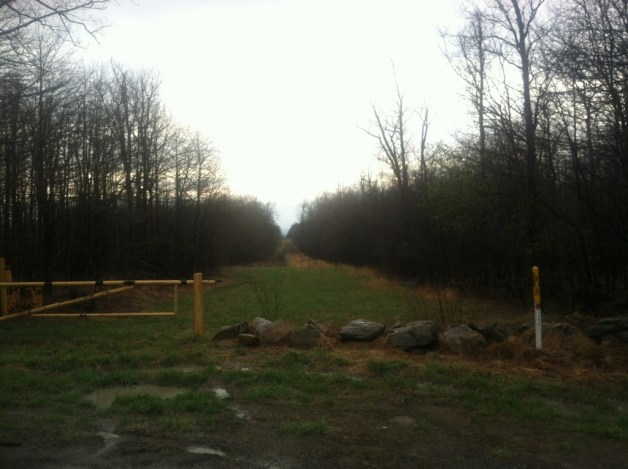
The hero workout, a day after Memorial Day

Murph lite:

1 mile run
50 jump pullups
100 pushups (various inclines)
150 squats

Tuesday was a milestone. I completed the Murph.

CrossFit is known for many things, one of which being the hero workouts. Named after military personnel who were killed in action, the workouts are a universally known activity that CrossFitters do together in a spirit of community.

One of the most popular is the Murph. Always done on Memorial Day, it’s pretty simple: 2 mile run, 100 pullups, 200 pushups, 300 squats.

Easy, right?

I’ve never known done the Murph before and was hoping to do this year. So, I was ready to go on Memorial Day, a hot, blustery day here in the District. Usually, I work the holiday but due to some creative maneuvering, I had the day off. I was ready to go.

And I overslept. Straight up slept in. Clearly off to a blazing start.

So, it went to Tuesday. By 8:30 a.m., it was nearing 80 and humid. Again, off to a blazing start. But I ran to the Rock Creek Parkway training course, resistance band and water in tow.

The resistance band wasn’t going to work and my upper arm strength still isn’t up to snuff, so it’s jumping pull ups for me. And I got going, 10 rounds of 5 pullups, 10 pushups and 15 squats.

And it got done in about 35 minutes, with a small break after round five. My arms are still feeling it but it wasn’t as bad I thought it would be. Mind you, doing the full Murph with stricter pullups would be a different story. However, considering where I’ve come from, this was a real success.

Then I tried running back for that second mile. Yeah, that didn’t happen.

Oh well, something to work on for next year.

Onward to the Odyssey-American Odyssey Relay review

Pre-Odyssey runs
4/13: 6.94mi, avg 10:07/mi
4/17: 5.46mi, avg 8:49/mi
4/19: 8.28mi, avg 8:38/mi
4.21: 4.06mi, avg 9:17/mi

Od-ys-ssey: n. A long series of wanderings or adventures, especially when filled with notable experiences and hardships.

It was intentional to a race going this quickly after the Rock and Roll Marathon. I’m fully recovered but the opportunity to run with good friends in such a venture was too good to pass up.

In its sixth year, the American Odyssey Relay is a 200-mile race from Gettysburg, Pennsylvania to the waterfront in southwest D.C. Runners traverse with through four states and a District, going around the clock to finish the job.

My friend Aaron invited me to join after a few runners of the Rabbits and Tortoises club dropped out of the race. One was running the Boston Marathon the week before, the other had another child on the way.

I’ve never done a relay before and while I was excited about the possibility, the thought of competing was a bit nerve-racking. I had to pull my own weight and make sure not to let the team down.

The relay is 36 legs total, ranging from easy to the exceptionally hard leg six. Runners run in order, so the person who did the first leg (in our case, our team captain Megan) also ran legs 13 and 25 and so on.

20140508-200617.jpg

The view from leg nine, post downpour.

Leg 9 -5.7 miles, hard

There’s nothing like a downpour in the back-country.

Little civilization to guide you, it’s you, your running shoes and the elements. And no matter what, the elements will win.

For my first run, I was afraid of the downpour. It would slow me down. It turned out to be a crucible, one that ended as soon as I started.

I was antsy. Being the second group, I didn’t get to run my race until more than nine hours after the starting line. So, we traveled through the battlegrounds of Gettysburg. I started my first leg nearly eight hours after our starting time.

Being in the backwoods, Runkeeper wasn’t really working, so the splits and times aren’t quite available. Neither was Pandora or Gregorian chants, so it was whatever music came to mind. Strangely, it was worship music. The kind my grandfather played on the organ. Here, on the Penn/Maryland border, I was singing “How Great Thou Art” with no one around but God’s creation. That’s something.

I passed two runners early on and had the whole course to myself, so much so I forgot to get on the left side. (Pro Tip: Run on the side where the cars can see you coming. You don’t want cars sneaking up behind you.) Toward the end, a runner came up behind me. Where did he come from?

He was moving fast but I wanted to be faster. He was elite, I was still an advanced amateur. He barely beat me but I’ll take it.

Leg 22-4.7 miles, medium difficulty

There’s running at night. Then, there’s running at NIGHT.

It’s dark, as the world intended. Runners in front look like junebugs along a darken route. It’s one of the most exhilarating moments ever.

I passed by a runner wearing an illuminated frog backpack. I almost went the wrong way, it was so dark and it’s rural.

After this race, I have that much more respect for the rural communities. One really has to know where they are going because it is so easy to get lost. Those long stretch of roads on the side. Fields and farms all around you. Open space. In a way, the open space can feel a bit suffocating, it overwhelms how much there is. There is so much and one just moves, a step at a time.

This leg took me from the Price Farm to the back way entrance of Antietam National Battleground. After living here six years, I know the Civil War happened in these parts but it’s still abstract. Seeing Gettysburg and Antietam brought a grounding to where I currently live and its place in history.

In this leg, I was moving and grooving. I passed several people (getting kills, as it’s called in race lingo) and ready for the baton pass. And yet again, someone comes up on me and almost passes me. I wasn’t going to be passed again, so I hustled up and flew right by him at the transition point.

20140508-200715.jpg

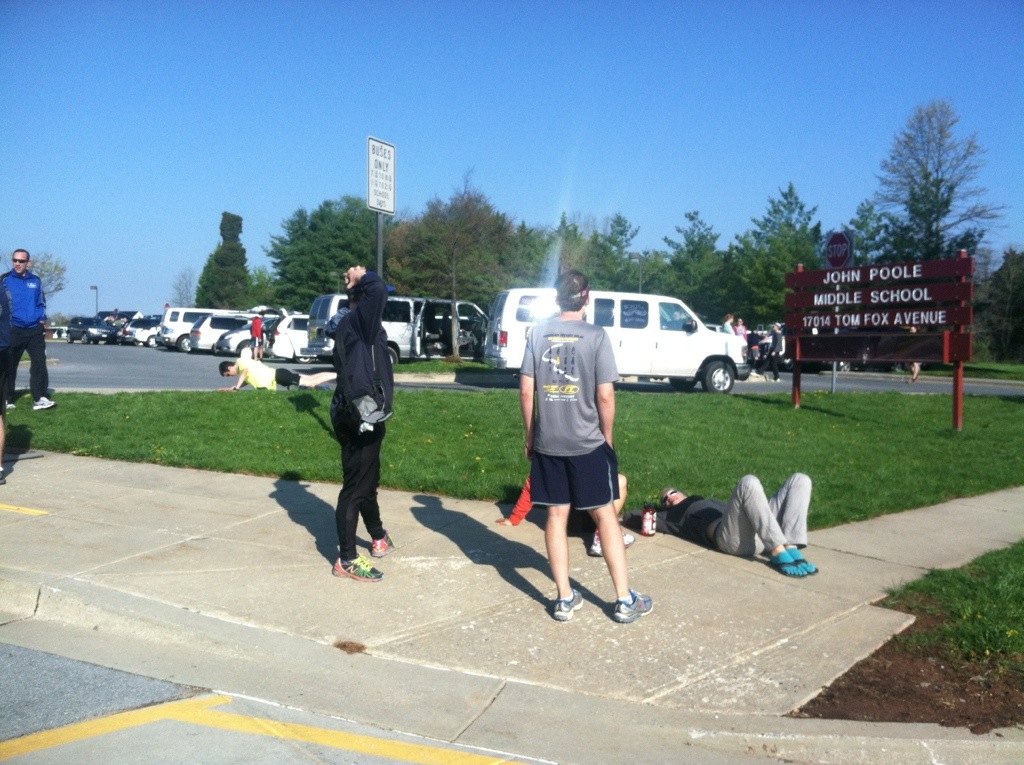
Waiting for our cohorts at Poolesville junior high school.

“Not this time,” I said as I passed the baton to Aaron. After we stopped, I went over to the guy and had a quick laugh and went our separate ways. It was around 1:30 in the morning and we were going around the clock.

Leg 33-8.3 miles, hard

Each van kept track of kills. Not road kills (although there were plenty) but runners passed along the way.

Such a funny thing. We’d pass people and we’re each applauding the other. The nicest way to die on the race, I say.

The way AOR works is that it’s staggered starts, with the faster teams going later. The aim is that the majority of the teams will finish in southwest about the same afternoon the next Saturday.

I was in the second van, which meant we started late and we finished the race. My two legs were right on the Pennsylvania border and in western Maryland. The relay would continue through Maryland to Harper’s Ferry, West Virginia and the start of the C & O Canal. At that point, it’s a near straight shot on the canal to SW Washington.

When the team was picking leg spots, I knew I wanted a challenge and wanted to feel like I could pull my weight. While I have made great strides in running in the near-two years that I’ve taken it up, I’m still a novice. The team had experienced runners and folks who are athletes.

I picked my spots knowing it would be tough but I didn’t realize until after we got together that I had the third-hardest leg route of the entire squad. Gulp.

The first two legs went well but it was this last leg, leg 33, that worried me the most. Not because of hills — it was mostly flat and easy to run — or because of weather (which was gorgeous) but it was length and time. Leg 33, on the canal from Great Falls to Fletcher’s Cove was 8.3 miles and the last big shot before the final legs to the end.

The team was doing very well. We knew we were making great time but we weren’t quite certain. So, there was little room for error. I mean, this wasn’t a hard-core competition but this is a relay.

So, Steve passed the baton to me and I got going. On routes like this, you worry about the monotony. No hills to climb, just a trail to run. And what a trail it is.

20140508-200828.jpg

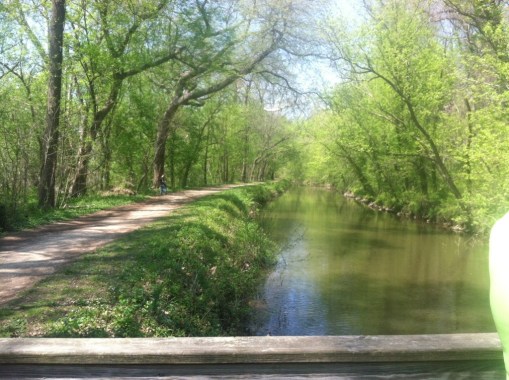
C&O Canal, Great Falls, Virginia.

I haven’t traversed up to Great Falls and this part of Virginia and today was the day for it. Mild conditions, lots of shade and really, the sight of perfection.

About 2/3 of the way through the leg, I heard footsteps. Eh, I thought, I was enjoying my run too much to care. Besides, who would come up to try and beat me?

The footsteps get closer until the guy comes up to me and puts his hand on my shoulder. It’s the guy from Antietam.

Such a beautiful day, I said.

It sure is, he replied. How are you doing?

Great, you?

Better than last night.

And with that, he took off. For a moment, I thought about trying to catch up but he was on the roll. He probably beat me to the transition point by at least 90 seconds. It’s going, I’m calling it even.

20140508-200807.jpg

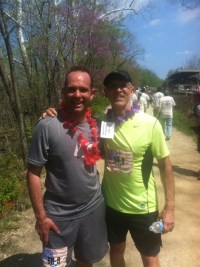
Mark and I, end of leg 33.

At the end, I took this photo with him and we chatted. His name is Mark and he was running the relay with his sons. I decided right there that I wanted to be like him when I grew up.

My legs were done and I did my part to help the team. Our part of the caravan got the last two legs on the canal, then rushed to Water Street for the celebration.

The tradition is that the entire team runs at the finish line together. We forgot to tell that to Eric, who was our anchor. He sped by all of us as we’re trying to catch him. Most were in flip-flops and severely sleep-deprived at this point.

But no matter. We started at 10:30 Friday morning and finished about 2:45 Saturday afternoon. Our placing: 27th out of 127 teams and 5th in our division (out of 51 teams).

Such a great job by the team and for me, one of the funnest experiences I’ve had.

This is why I took up running: It has opened up new doors and opportunities to meet some amazing people who I would have never had ever imagined. And for that, I’m so grateful. And I keep going on this road to good air.


Confessions of an accidential caveman #3: Time for spring cleaning

20140415-234632.jpg

Tidal Basin at sunrise, Cherry Blossoms in full bloom.

It’s finally spring!

Warmer temperatures, nicer breezes and more pleasant faces on the street. Most important, I can wear my shorts and no one is going to look askance. Thank God for that!

Of course, it’s time for spring cleaning. Get into the closets, give away the old clothing and for me, give up caffeine and sugar.

Say what?

This started during the Whole 30 challenge. Aside from my struggles with fast food and having a consistent eating schedule, coffee (medium roast, please!) and sugar are my biggest addictions.

I love coffee. Love. It. I started drinking coffee when I would have my dad push start his beaten up Honda that had one  tail light perpetually out. We called the car “The Terminator” because one side of its face was jacked up but it still kicked ass.

He would always leave a cup of coffee for me after I went back into the house.

My friends and I had a comedy troupe in high school and we eventually manufactured a coffee drink.

It was as follows: Strong coffee, 10 packets of sugar, 5 gulps of milk. Per cup. Man, it was good. We would drink that stuff and practice our Monty Python ripoff skits.

We were men, I tell you.

Coffee holds a special place for me. I’m always on the quest for the perfect coffee house (right now, it’s a tie between this one and this one) and the best blends. I’m a total snob, preferring a French Press to automatic drip, even though those Clever pots seem mighty enticing these days. It’s communal, it’s solitary and it’s a common string through so many of my life experiences.

I drink a lot of coffee, at all hours of the day. Although my age and wisdom now prohibits me from getting quad mochas at 7 p.m., I easily drink 3-4 cups a day. Start with two in the morning, then one stop at the coffee shop on the way to work. It doesn’t matter if I “need” the extra coffee, it’s part of the routine.

Last year during my Whole 30, I gave up coffee in addition to the food detox. It’s not required but I knew I needed to do it. It was the first time I stopped drinking coffee since I was age 13. No doubt, it hurt. The headaches, sensitivity to light and the inability to focus was on the docket for the first few days.

Then, combined with the detox itself, was a foggy blur for about two weeks. A near-dream like state, the body is trying on new ways to have energy while reminding you of what you’ve been using as fuel all these years.

After that experience, I wanted to do a caffeine holiday at least once a year and this time, it’s not a moment too soon. I consumed so much coffee during this painful winter that I’m up to 4-5 cups a day by the afternoon. That’s too much.

Then, there’s sugar.

I’ve mentioned before that I have a major sweet tooth and have used sugar as my mode of emotional eating for as long as I remember. Candy, cake, sweets galore: All of it, I ate it.

Sugar is the drug of choice in most newsrooms these days (although I’m sure there are other substances around somewhere) and it’s so readily available and permissible in our culture.

Now, I’ll stop here and say this: Sugar and caffeine like most things are not bad in and of itself. It’s meant to be enjoyed. Most addictions are distortions of something that is good and coffee and cookies are no exception. The issue isn’t having a cup of coffee or eating a cupcake but rather creating dependency on them to cope.

Also, when I say sugar, I mean refined and artificial sugars. Natural sugars found in fruit and other foods is healthy and good for you. (I also note that some in the paleo community don’t agree with eating those kinds of sugars but those are natural and unavoidable and not chemically induced, so I see no problem with them.)

I gave up sugar as well and that was a game changer.

So, it’s April and it’s time for a holiday. I’m about 15 days in and well, it’s been mixed.

Instead of going cold turkey on coffee, I aim for one cup of decaf, then will go no coffee for the rest of the month starting on the 14th. Even cutting down to decaf was a struggle. The headaches and lethargy were all there but really, it was the lack of concentration and focus. I was focused on my head, my sinuses, how much I hated doing this work shift, how much I hated the winter, why I slowed down toward the end of the race, how this shirt doesn’t fit as it should…..

Yeah, a bit of a struggle.

Sugar was even worse. I transferred my addiction from regular cookies to vegan cookies and my god, they are sublime. So, those are out. Candies in general, which I have been pretty good at, were out. And ice cream. I love ice cream and got the point of eating a pint without a second thought. Hell, I probably didn’t give any thought to it in the first place.

The biggest issue are protein bars. I’m on the fence on this one and because I’m still training for the Relay at the end of the month, I’ve been going with them. They do have sugar in them and I’m burning through it quickly.

Aside from a major relapse at Menchie’s over the weekend (damn you frozen yogurt!) and a Snicker’s bar today because the the cafeteria were out of Clif bars (most likely because I ate them all) it’s been okay. As the folks at Whole9 point out, sugar is everywhere in various forms and it’s hard to figure out what items has sugar and what doesn’t. I did get the BBQ sauce for dinner two nights but other than that, I’ve been sweet-free.

And most importantly, no ice cream.

This often means a switch from sweet to savory. Instead of cookies, it’s salty almonds and seeds. More fruit gets into the mix, with an emphasis on berries with anti-oxidants. The counteracting helps the body’s desire for sweets and tries to balance it out.

I feel the change already. I am sleeping better during the night and having to take some naps during the night because I realized how I tired I was despite being hyped up on coffee. The sugar spikes are dissipating, as well as the crash.

The holiday lasts a month. It’s good to recalibrate the energy levels and remind yourself that you don’t need coffee and don’t need sugar. It’s not necessary to get through the day and live a healthy life. It’s a good reminder to forgive out what exactly you need to live a healthy life.

Let’s talk: Have you taken a food holiday? How did it go? Were you sitting in the back screaming, ‘Are we there yet!!?’ or was it okay for you?


Rock and Roll Marathon: Homeward Bound

Note: I’m late on the recap as this past few weeks have been swamped and I also spent a good chunk of time working on this piece for the Post. This is the last element on my list so I can say I have fully recovered.

I still remember when my good friend Greg asked me if I wanted to go running with him. He was picking it up, running from his house to the place where we both worked. He wanted to do a 5K and wanted to see if I would be interested.

I wasn’t. Not even close. He started running and continued when he and his then-pregnant wife moved to Missouri about three years ago.

Imagine our good fortune that he and I would run the D.C. Rock and Roll Marathon together. He stayed with me and my place and it was a wild and crazy weekend. If, of course, one defines wild and crazy by me making healthy food and he talking with his wife and two-year-old daughter.

gregandI

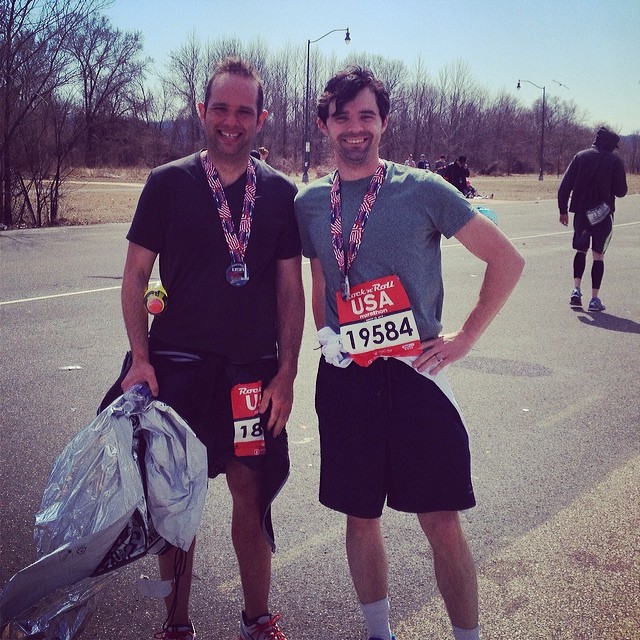
Me, on the left, and Greg. From his phone. Spoiler! We both finished the race.

Indeed.

This was his third marathon and my second. Our goals were to go a bit faster. I’ve focused my training this winter and speed and consistency and we had great weather to make it happen. My individual goal was to start at 9:30, and eventually get to 9:00 mile pace. With luck, that would get me to close to the 4:00 mark.

The second marathon is tougher than the first. The first is the experience: You run to run, aiming to finish but really to experience it. Of course, you want to do well but you have nothing to base it on, so just get going. Really, the point of the first marathon is to do it, then decide how serious you want to get about running or move on to the next item on the bucket list.

After Argentina, I was hooked and I wanted to become a better runner. Training through all the bitter cold was a bit of a crucible. Aside from using the training to help endure the season, it provided a backdrop on how seriously I would take the training.

When it was time for the marathon, I felt stronger and better. And I felt smarter about the course, perhaps a little too smart.

The tricky part with the Rock and Roll Marathon is that everyone runs the first 12 miles together, then splits off to their respective destinations. The first part of the race was well-known, as I run much of those streets often. It was a thrill, albeit a crowded thrill.

The second part was different. A good different but different. Crossing by the Capitol to the Expressway, getting to the Waterfront, going by Nats Park, then the long stretches in Anacostia and Minnesota Ave on the way.

I run the first stretch of the course often and since I ran the half in 2013, my confidence was high. I knew going into the marathon that this would be two different races: One with all the people and one without.

It’s great to see friends cheering for you, especially having charging Rock Creek Parkway up to Calvert St in Adams Morgan. By the time the half and full runners split, I was in good spirits.

Then at about mile 18, it got hot. Coming through Anacostia Park, it’s a long stretch of trails and grassy knolls. And no shade. No, none, nothing. The weather was all over the place that morning; Cold and windy, calm and serene, then hot.

I intentionally passed on the early water stations because I wanted to avoid the crowds. Even though I had my own water, I was struggling to get hydrated enough. My legs were hurting and I was losing energy, so I had to take some walking breaks.

My trick with walking breaks is pretty simple: Once I start walking, I count from 20 down. The point is to make the break finite, give myself enough time to catch my breath but not enough time to lose the rhythm and make it harder to start running again. There was a few times where 20 seconds was 30 seconds but that trick really helped.

Those hills on Minnesota Avenue toward the end of the race were a killer as well. It was the Wall, of sorts. Mostly hydration and energy and somewhat psychological. I knew this course because I live here. But yet, there was so much of the course that I didn’t know that I could have strategize a bit better.

At any rate, I caught my last wind and ran the last few miles full stride and made it to the end.

Times:
5k: 28:35
10k: 57:17
10 miles: 1:32:23
half: 2:01:05
20 miles: 3:07:52
chip time: 4:11:46
avg page: 9:37

As you can see, I started well and maintained about a 9:15 pace toward the half mark, then slowed to about 10:15 pace toward 20 miles. I finished about 10 slower from 20 to 26.2 than my first 10K, thus how I ended up at 4:11.

Me, finishing the race. Care of MarathonFoto.

Me, finishing the race. Care of MarathonFoto.

For my first marathon that I care about my time, this was a rousing success. I ended up nearly 40 minutes faster than my Buenos Aires time and more so, got to run the race with one of my closest friends in the city we both love.

Up next for me is the American Odyssey Relay at the end of April and then, we shall see what is next in the quest to join the Seven Continents Club.

How I Met your Mother finale — We tell stories to let go

And now for something completely different…

It’s been a week and most people have gotten over the shock of the How I Met your Mother series finale. There are gazillions of opinions on the internets about the show and whatnot but this was one of my favorite shows and it resonates with me. Thus, my $0.02.

Hindsight is 20/20 and hindsight can be a real bitch. Many things are a real bitch, but clarity on things past is one of the nastiest known to humans.

That type of clarity can be cold and unforgiving. Regrets, miscues, missed opportunities and saddest of all, broken relationships. Life is lived forward and understood backward but that understanding often comes as the second chance at living correctly.

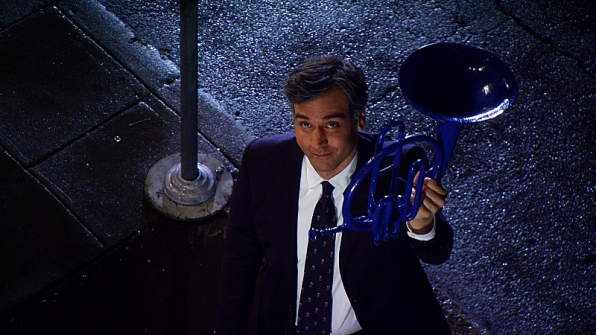
In How I Met Your Mother, the series ends up being (and where the digital wailing and gnashing of teeth begins) of the father reliving stories about his wife who has passed on and when called on it by his daughter, reveals he wants to ask out their Aunt Robin. The ending circles to the beginning with Ted outside Robin’s apartment, blue french horn in tow.

Ted and the blue horn.

Ted and the blue horn. From CBS.com.

Type in #HIMYMFINALE on twitter and the responses are beyond amazing. Mostly negative, some positive but all personal, it’s CBS’ biggest dream come true to have that type of emotional response to a show.

The most interesting word in many reviews, for me, is betrayal. Fans and critics feel betrayed that the show turned out the way it did. Some say the finale betrayed the ideals of the show, others claim it betrays the fan’s relationship to the Mother, who was just introduced, then taken away. Right or wrong, that’s quite the word to use for a television show finale.

Betrayal comes from a failure to keep a commitment or expectations. Promises and vows that were sealed are unsealed. In this case, did the show turn back on its commitment in telling the story of how Ted met the mother of this children?

Well, no, with more major caveat.

Most shows, movies, book and etc work under the idea called suspension of belief. This means that by watching the show or reading the book, the reader/watcher agrees to the narrative framework set up by the writer. One will buy into whatever is coming his/her way to be in the story. The only trick is that the writer can only do this once, if there are too many “suspensions,” then the reader won’t engage.

With HIMYM, audiences were fully engaged with the characters and with the story. However, where much of the betrayal is coming from is audiences not engaged fully with the most influential character on the show: Not the Mother, but time.

In order for HIMYM to fully work, the watcher has to accept time on the show’s standards. Thus, the present day was 2030, and in our present day of 2014, Ted and the Mother (her name is Tracy McConnell but it’s hard to call her that since she was the Mother for so long. For me, that is one knock on the last season.) are together with baby Penny on the way.

With time, what’s true that one time is true that one time, but it isn’t true all the time. (How’s that for a little blog wisdom?!). Meaning, in that moment, that’s what happened, that’s what was felt and that’s what mattered. So, in 2005 when the show started, Ted and Robin did meet and did try to make it work and eventually couldn’t make it work. Then, Barney fell for Robin and during that time, they tried to make it work. The same is true for the Mother, who lost her first love in 2005 it took her years to regain a sense of finding companionship again.

For the ninth season that was the weekend of the wedding, in that moment, Ted did have feelings for Robin but let them, and her, go. It meant leaving for Chicago but that’s what the times called for. And, despite the last-minute hesitations, Barney and Robin did get married.

It’s tough in translating these movements of time in a linear format such as television and that’s where most folks are getting lost in translation and thus, the sense of betrayal. Of course, if we spent most of this brutal winter watching Robin and Barney get married only to have that fall apart within the first 15 minutes of the finale, there is a strong sense of cognitive dissonance. Frankly, it wouldn’t surprise me if the creators aimed for that to a certain degree.

But, in the eyes of the narrative, it was three years and for them, that was enough.

In my opinion, embracing all the narrative (time and all) helps to recognize what the show was really about: HIMYM is a story about letting go.

For me, the key part was in season nine in “Vesuivus.” The Mother tells Ted that she’s concerned, saying “I don’t want you to live in your stories forever. I want you to move forward.”

It was subtle but that’s the key. Ted is telling the story of how he met his mother to remember and preserve her memory but also to let her go to face the future. Ted tells all the stories about everything the gang ever did: The slap bet, Robin Sparkles, the pineapple incident (Whatever did happen with the pineapple?) and one of my favorite episodes, The Leap, because they are all a part of his memory and what makes him who he is at that present time.

And when that time passes, it doesn’t make him that person anymore.

It’s not that Ted has been in love in with Robin all this time and the Mother was a placeholder. The title of the show might be a fake-out, as actor Josh Radnor put it, but I think he really did let Robin go and full fully in love with Tracy. That seems to be Ted’s way, all in with no pretenses or excuses.

It just so happened that all of this was shown in a 44-minute setting. Time-wise, that’s pretty jarring. Then again, isn’t that true of all our stories? Our stories about funny events with our friends are often, well, short. But the reality of them, the life that’s filled with time that we try to encapsulate in a small moment, is both long and deep and there’s no way to bring it back We just hold it for a moment, then let it go.

I think that’s what allows the kids to tell their father that he should move forward. In the time of HIMYM, it was six years since Tracy’s passing. The question isn’t if that is an appropriate time to move on or not but rather, was it the right time? And for Ted, it was.

The characters are roughly the same age as me, so I feel I’ve grown up with this show. I did leave during some of the latter seasons (because seriously, I couldn’t stand Zoey and Barney’s antics were often a little too much) but I watched faithfully this past season and I’m glad I did. I haven’t met the mother of my children on a train station in a fictional New York town but I have lived my 20s and 30s in an urban environment with many of my friends and I can relate with Ted’s quest for love.

So, like the show says, it’s time to take the leap, get to the station and say hello.

*Also, you gotta applaud Carter Bays and Craig Thomas for playing out with the Walkmen.*

Find your rhythm, one chant at a time…

It’s a question of belief whether divine intervention can help your fitness program, but I can attest that God’s music can make you  a faster runner.

When it came time to train for my second marathon, I turned to Giovanni Pierluigi da Palestrina. Palestrina wasn’t a running coach but a 16th century composer of  sacred music. His compositions, still sung in Masses worldwide, helped revolutionize choral music in religious settings in the Western world.

A friend recommended I listen to jazz, because the improvisational style can aid in finding rhythm. It didn’t help. On a whim, I switched over to the Palestrina station and heard the Gregorian chants. Soon I would find them, well, instrumental to my fitness program.

In my guest post on the Washington Post’s To Your Health, I explain how Gregorian chants and attending the Church of the Long Run helped me focus and get faster. Read more here. And thanks to Lenny Bernstein and the Post for the opportunity!

D.C. training #7: To the starting line, once again

3/7: 5:03mi, avg. 8:38/mi
3/8: 6:01/mi, avg. 9:09/mi
3/11: 4:79/mi, avg, 9:00/mi
3/12: 3.77/mi, avg. 8:45/mi

Winter is taking one last pass through, a victory lap perhaps. It surely did win the past few months. It goes without saying it has been one of the most brutal winters that I’ve experienced and as you can read from the posts, one of the hardest to train in.

But here we are. The Rock and Roll marathon is Saturday and weather should be good. Light wind, some precipitation but nothing too extreme. Assuming metro runs on time, it should be a smooth time getting to the starting line. I feel a sense of “good tired.” This winter wiped me out, my eyes are still adjusting to moisture in the air and my lungs aren’t quite sure how to deal with milder breathing. It should lead to better running on Saturday but it is an adjustment.

My friend Greg comes up to D.C. tonight and it’ll be great to run the race with him. He was one of the initial catalysts for getting me to start running, for which I greatly appreciate him.

Not much more to say at this point, other than I’ll see you at the starting line!

D.C. training #6: Pockets of sunshine

2/25: 3.66mi, avg. 8:59/mi
2/26: 8:00mi, avg. 8:31/mi
3/1: 6.04mi, avg, 9:10/mi
3/2: 9.88mi, avg, 8:59/mi

It’s snowing. Again.

But really, it doesn’t matter. The past two weekends consisted of mild weather and pleasant winds, so that allowed me to finish long run weekend and the last of the long runs yesterday.

I forgot how quickly dehydration sneaks up when the weather gets hotter. Yesterday’s long run was good but without the Mall’s fountains still not working and me forgetting my water bottle, I was hurting a bit toward the end.

Now, it’s time to taper. My taper experience with the maratón was difficult. I don’t expect much trouble this time because the race is on home turf and the last vestiges of winter will keep me occupied.

Here’s hoping the lamb-like end of March starts by March 15!

Six years (The daily commute)

Note: Six years ago today, I moved to the D.C. area. Six years!

Each day, I take the Metrobus to work. It is my best commute so far in my professional life, a near straight line to downtown.

I know the drill. Wait for people to come off, say hello and how are you to the bus driver, pay with the SmartCard quickly. If you need to put money on the card, have it out and ready to go. You have to press your card against the meter twice after activation.

Walk to the middle back. The seats up front are for those who need chairs and the mothers with crying children. Or the crying mothers with children.

Say hello to the Cuban, a nice fellow who lives near the Giant grocery store on Park Road. He hums a tune, unless he’s talking to someone about how the government is messed up. Everyone talks about how the government is messed up but from him, it sounds poetic.

People will move their legs from the aisle if you step over. Go to the back, find a seat, check your phone. Usually, it’s nice to listen to music or a podcast. Catch up on the news or check the newsfeed on Facebook once again. The goal is to drown out, not tune in. It’s a sad fact that drowning out is the default measure but you need to save energy for deadline.

Sometimes, the drunks come on board. The majority are nice drunks, happy as they can be in that moment. The worst are the lamenters because their goal is to have me join them in their current downward spiral.

All the change on 14th Street! Even in the few years I’ve lived in the District, I’ve seen the neighborhood come and go. That new condo is taking over where the old Salvadoran restaurant used to be. I went there once and it was okay. I can see why it’s gone.

The bus passes through Thomas Circle. I exit on L St. Stop for more coffee but I don’t really need it.

Work, then the shift is over.

MacPherson Square is the best place to wait for the bus because it provides options. The line up 16th Street is faster but more annoying. Besides, the 42 is better. Crazy happens on the 42 often but that’s why I ride it. It’s worth the price of admission. Just sit in the back and be amazed.

Traveling past the bars on Connecticut Avenue, it’s a constant wonder: Why the hell do people subject themselves to these places? I take pride in never clubbing on Connecticut Avenue, except that I remember I did go clubbing once or twice and really, it wasn’t that bad. Kinda fun, actually.

Working late means joining the fellow swing shift workers. We keep the world running. Cooks, dishwashers, waiters, designers. It’s grunt. It’s production.

Get off in Mount Pleasant, stop by 7-11 for water and the extra Clif bar. Man, those Clif bars have become the new Snickers. I haven’t decided whether that’s good or bad but I need all the protein I can get. So back off.

My friends give me a hard time about walking in my neighborhood late at night but that’s the best time to be out. It’s quiet. If anyone messes with me, I go to the middle of the street and stop and dare them to join me. Usually, they don’t care that much and move on.

I’m home. Check my mail, turn on the space heater because winter is still going on and put my stuff down.

Home. That’s the word you’re trying to remember. Home. How did this place, this space become your home?

Who’s idea was it? Yours? God? Neither or both? This is all Malcolm Gladwell’s fault. He was the one who said to blink.

The test, Gladwell says, is simple. Think of your dilemma or situation. Close your eyes and count to five. When you open your eyes, notice the first thing that comes to mind. Try for that.

You take his test. When you opened your eyes, you are on an Alaska Airlines flight, direct to Reagan National. Wearing shorts because it’s too uncomfortable to wear jeans on a plane, you lined up a possible sublet, vague job possibilities and enough cash for three months.

You blink again and you’re standing in front of the White House just after Obama’s election. It was quiet, just you and some kids playing soccer. In about 15 minutes, 3,000 people would fill this space. More will celebrate on U Street and H Street. You text Lys and tell her this is the most incredible moment ever. It was.

Earlier that day, you and Buck stood in a mass of folks, waiting to get in. A sly joke gets you into the Washington Post. Four years later, you’re working election night for them.

Another blink: Twenty-six inches of snow. Snowmeggedon 2010. You’ve never seen this much snow. Huddled in your apartment with episodes of Get Smart and no Internet, you realize this wasn’t the adventure you had in mind. No job, no prospects, just frozen pizza. The storm ends and you join others outside. The city is at peace and strangely, so are you.

You open your eyes to see your friends around you on your 30th birthday at Westminster Presbyterian’s Jazz Friday. 30. Yeah, you can see why people shit their pants over this age. But for now, you’re happy you made it.

One year later, you’re in a HOLE. Your best friends who threw you the party last year are gone. Many of your friends are gone. The calling is gone, the dreams are gone. You try to close your eyes and pretend like it’s not happening but your eyes and life are wide open. This isn’t fast. This is very, very slow.

Trying to stay awake, you strain to keep your eyes open. It’s 2012. Adrian is still reading. When you started, he was in the second grade and one of the best readers. Man, you lucked out. You blink again: It’s June 2013 and he’s off to junior high. You give him a copy of The Westing Game. That was your favorite book when you were his age. He says it’ll be his favorite book too.

You blink once more and you’re on 14th and Euclid in the dead of winter 2012, with the instruction that you’re going to run a marathon soon. Marathons, in fact.

You blink to get the sweat out of your eyes. Running in a D.C. summer is a pain in the ass. You stop at Meridian Hill Park. You just ran 20 miles for the first time in your life. This is the spot where you did your first run. That time, you barely made it through one lap around.

Thirty is now 33. According to the calendar of the Middle-Aged Young Adult, this is the last year you can claim your mistakes on being young and stupid. After this, you’re just dumb.

Lately, you’ve been trying to blink extra hard to see the future. Certain things show up: Athens, Capetown. More words. Family, wife, children. …blurry and abstract but very much there.

Otherwise, it’s the same image over and over again.

Open.

That’s it, just open.

But that’s what to come. And sheesh, haven’t you learned your lessons about knowing before leaping, yet? Pay attention. Stop with the sentimental. Work is to be done.

The District is home. Somehow, this foreign spot became my walking, my knowing. I know this place now.

I know where to go and what to do. That knowledge is automatic and routine but every so often, I will remember how painful it was to gain that knowledge. It almost didn’t happen.

All the thoughts about leaving, all the phone calls about staying, all of it. I remember.

I’m not a native and not establishment but I belong through hard elbows, perseverance and semi-dumb luck.

Every walk to get coffee, every time I went to church and every time I’ve longed for Church and Community but it just didn’t happen, I belong.

People like to say you’re either in or you’re out. That’s not true. That dichotomy is false and really a point of insecurity on that people’s parts. The truth is you’re in because you choose to be in and made your case of worthiness in a successful fashion.

Besides, this city was built on the premise that no one could belong here so that everyone belonged. It just worked out for some to build a house along the Potomac to keep their lack of belonging in an influential spot.

It still doesn’t answer the word: Home. No matter. It doesn’t need an answer now. All that matters is that the word isn’t a question or a resignation; it’s a sigh of wonder. And God.